

AIPMT PRELIMS 2005 Chemistry Isomerism in Coordination Compounds MCQ Question
Which one of the following is expected to exhibit optical isomerism? (en = ethylenediamine)
cis-[Pt (NH₃)₂ Cl₂]
trans-[Co (en)₂ Cl₂]
trans-[Pt (NH₃)₂ Cl₂]
cis-[Co (en)₂ Cl₂]
Correct Answer
Detailed Explanation
The correct option is (2) .
Step-by-Step Explanation
Optical isomerism occurs in coordination complexes that lack an internal plane of symmetry () or a center of inversion (). Such molecules are chiral and can exist as a pair of non-superimposable mirror images (enantiomers).
1. Analysis of Pt Complexes (Options 1 and 4)
- Both and are square planar complexes ( has a configuration with strong/medium coordination).
- All square planar complexes have a plane of symmetry (the molecular plane itself contains all the atoms).
- Therefore, they are achiral and cannot show optical isomerism.
2. Analysis of the Complex (Option 3)
- This is an octahedral complex where the two monodentate chloride () ligands are situated opposite to each other ().
- The two bidentate ethylenediamine () ligands lie in the equatorial plane.
- This arrangement has multiple planes of symmetry (e.g., the plane cutting through the cobalt and the two ethylenediamine ligands, or planes bisecting them).
- Because of this symmetry, it is achiral and optically inactive.
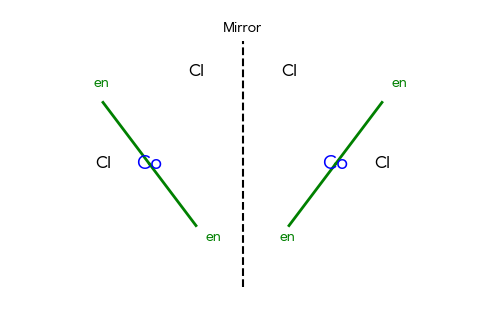
3. Analysis of the Complex (Option 2)
- In the cis-isomer, the two chloride ligands are adjacent to each other ().
- This specific geometric arrangement destroys all planes of symmetry and centers of inversion.
- Since it has no element of symmetry, the complex is asymmetric (chiral) and forms non-superimposable mirror images:
As a result, exists as a pair of enantiomers and exhibits optical isomerism.
Found an issue with this question?
Related Questions
More from 2005
AIDS is caused by HIV that principally infects:
Assertion : The logic gate NOT can be built using diode. Reason : The output voltage and the input voltage of the diode have 180° phase difference.
In a semiconducting material the mobilities of electrons and holes are μₑ and μₕ, respectively. Which of the following is true?