

RE-NEET 2026 Physics Viscosity MCQ Question
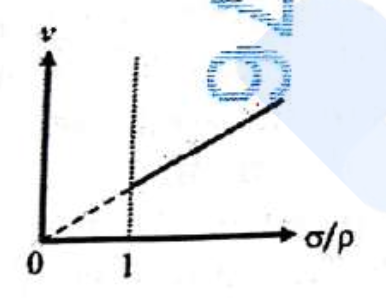
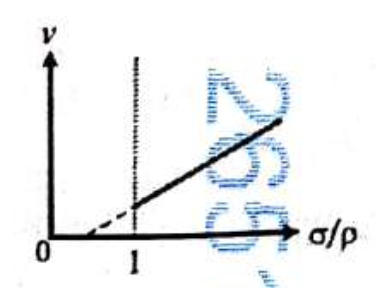
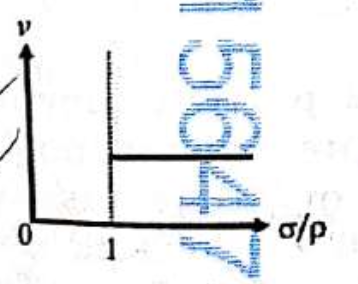
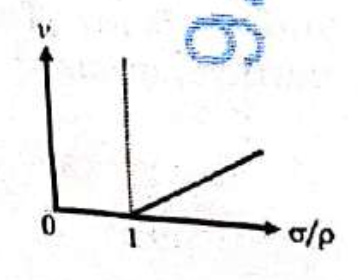
In the measurement of viscosity of liquids using terminal velocity experiment, spherical balls of same radius but having different densities are used. The variation of the terminal velocity (v) with the ratio of density of spherical ball (σ) to density of the liquid (ρ), is best represented by:
Correct Answer
Detailed Explanation
To analyze the terminal velocity of spherical balls of the same radius but different densities in a liquid, we need to understand a few key concepts related to fluid mechanics and viscosity.
Explanation of Terminal Velocity
When a spherical object falls through a viscous fluid, it eventually reaches a constant speed known as the terminal velocity (). At this point, the gravitational force acting on the ball is balanced by the viscous drag force exerted by the fluid. The forces can be expressed as follows:
-
Gravitational Force (): This is given by the equation: where:
- is the volume of the sphere,
- is the density of the ball,
- is the acceleration due to gravity.
The volume of a sphere can be expressed as: Therefore, the gravitational force can be rewritten as:
-
Viscous Drag Force (): According to Stokes' law, the drag force experienced by a sphere moving through a viscous fluid is given by: where:
- is the dynamic viscosity of the fluid,
- is the radius of the sphere,
- is the terminal velocity.
Balancing the Forces
At terminal velocity, these two forces are equal: Substituting the expressions for gravitational force and drag force, we get:
Simplifying the Equation
By simplifying this equation, we can isolate the terminal velocity :
- Cancel out common terms:
- Rearranging gives:
Ratio of Densities
The ratio of the density of the spherical ball to the density of the liquid can be defined as: Substituting this into our equation for terminal velocity: This shows that terminal velocity is directly proportional to the ratio of the densities:
Correct Answer
From our analysis, we can conclude that there is a linear relationship between terminal velocity () and the ratio of the densities (). This relationship is best represented by a straight line through the origin, indicating that as the ratio increases, the terminal velocity also increases.
Conclusion
Therefore, the correct answer is indeed D, as it captures the linear relationship between the terminal velocity and the density ratio.
Clarification of Other Options
If options A, B, and C suggest non-linear relationships (such as quadratic or other complex forms), they would be incorrect because our derived equation demonstrates a simple linear proportionality. The terminal velocity does not depend on the square or any higher powers of the density ratio, reinforcing that the relationship is straightforward and linear.
In summary, the correct answer is D, as it appropriately reflects the linear relationship between terminal velocity and the density ratio of the spherical ball to the liquid.
Found an issue with this question?
Related Questions
More from 2026
Arrange the following in the correct developmental sequence related to microsporogenesis:
Match List I with List II:
Choose the correct statements regarding cell organelles and their inclusions. A. The endomembrane system includes Golgi complex, endoplasmic reticulu...