

NEET2015Physics-First Law of Thermodynamics
NEET 2015 Physics First Law of Thermodynamics MCQ Question
Type: MCQ-diagram based-Medium-Class 11
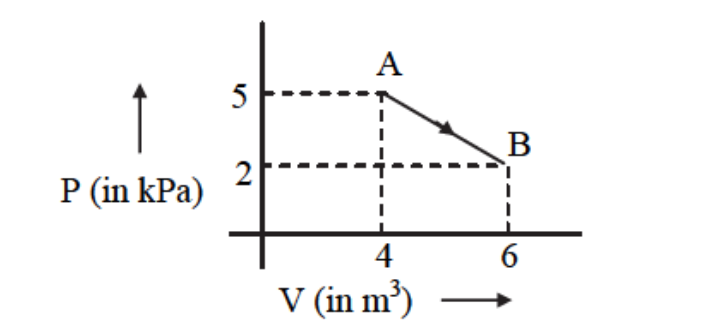
One mole of an ideal diatomic gas undergoes a transition from A to B along a path AB as shown in the figure. The change in internal energy of the gas during the transition is
A
20 kJ
B
-20 kJ
C
20 J
D
-12 kJ
Correct Answer
Option B
Detailed Explanation
For an ideal diatomic gas, internal energy depends only on temperature: for one mole. So,
At : and at : .
Hence,
So the correct answer is B.
kJ has the wrong sign, J is far too small, and kJ is just the raw difference, not .
Found an issue with this question?