

NEET 2015 Physics First Law of Thermodynamics MCQ Question
Figure below shows two paths that may be taken by a gas to go from a state A to a state C. In process AB, 400 J of heat is added to the system and in process BC, 100 J of heat is added to the system. The heat absorbed by the system in the process AC will be
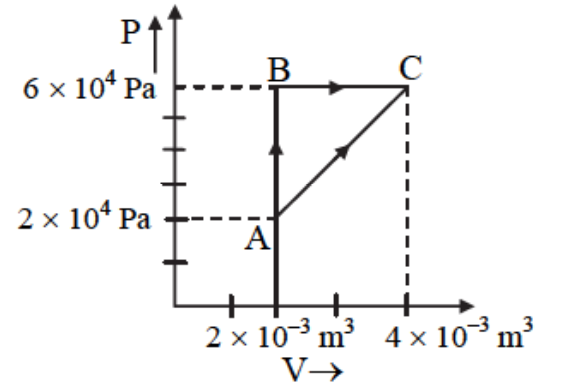
380 J
500 J
460 J
300 J
Correct Answer
Detailed Explanation
To analyze the question regarding the heat absorbed by the system as it transitions from state A to state C through two different paths (AB and BC), we will apply the First Law of Thermodynamics. This principle states that the change in internal energy of a system is equal to the heat added to the system minus the work done by the system.
Given Information:
- Heat added in process AB:
- Heat added in process BC:
Finding the Heat Absorbed in Process AC
The total heat absorbed by the system when going from state A to state C (denoted as ) can be determined by adding the heat absorbed in both segments of the path:
Substituting the values:
Thus, the heat absorbed by the system in process AC is 500 J.
Conclusion
The correct answer is B) 500 J.
Clarification of Other Options:
- A) 380 J: This option does not account for the total heat added in both segments correctly.
- C) 460 J: This value is also incorrect as it fails to accurately sum the heat added in both processes.
- D) 300 J: This option is incorrect; it underestimates the total heat absorbed by not including the contributions from both paths.
Summary of Key Concepts
- The First Law of Thermodynamics is crucial here, as it allows us to relate heat added to the system to the overall change in energy.
- The total heat added when moving through different paths in a thermodynamic system is simply the sum of the heat added along each pathway, as internal energy is a state function.
By understanding these principles, you can efficiently analyze similar thermodynamic problems in the future!
Found an issue with this question?