

NEET Physics Time Period & Frequency MCQ Question
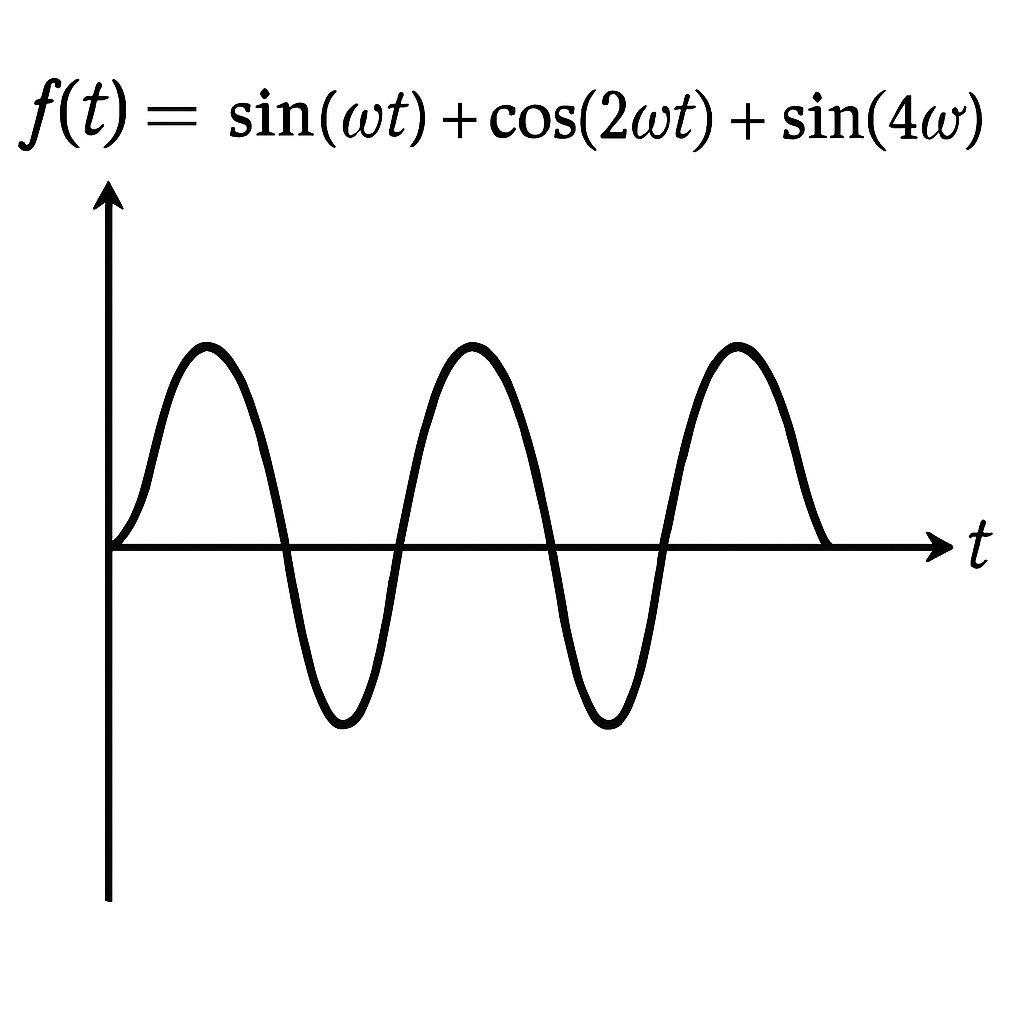
Consider a periodic function expressed as a superposition of sine and cosine functions with different time periods. If you have a function f(t) = sin(ωt) + cos(2ωt) + sin(4ωt), which of the following correctly describes its periodic nature?
The function is non-periodic due to different angular frequencies.
The function is periodic with a period of 2π/ω.
The function is periodic with a period of 2π.
The function is periodic with a period of π/ω.
Correct Answer
Detailed Explanation
According to the context, a function like sin(ωt) + cos(2ωt) + sin(4ωt) is periodic and the period is determined by the largest common multiple of the individual periods, which is 2π/ω.
Found an issue with this question?
Related Questions
More from Time Period & Frequency
More from
Assertion (A): The acceleration in simple harmonic motion is always directed towards the mean position. | Reason (R): In simple harmonic motion, accel...
What is the relationship between the driving frequency and the amplitude of an oscillator in Simple Harmonic Motion?
What happens to the mechanical energy of a damped oscillator during its motion?