

Physics-Time Period & Frequency
NEET Physics Time Period & Frequency MCQ Question
Type: MCQ-diagram based-Medium-Class 11
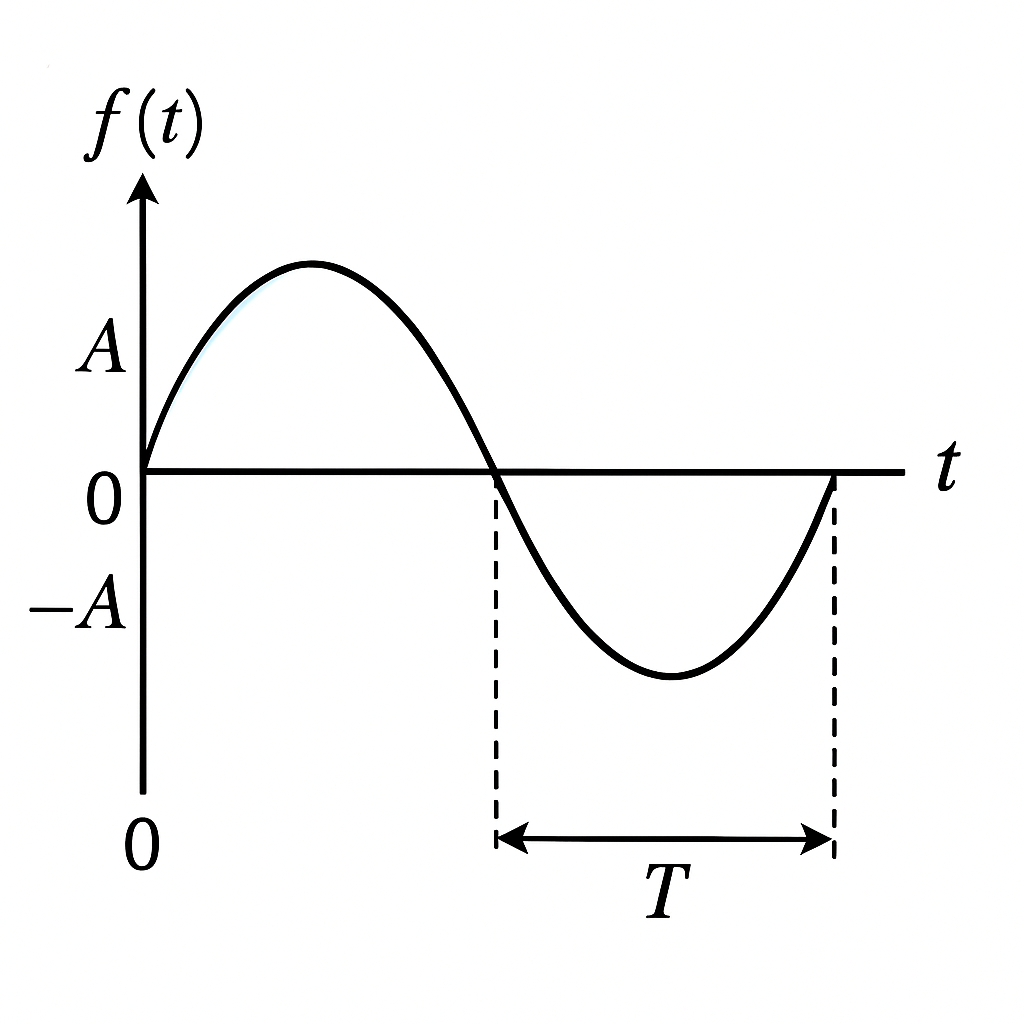
Consider a sinusoidal function f(t) = A sin ωt + B cos ωt representing an oscillation. Which expression represents its time period T?
A
T = 2π/ω
B
T = ω/2π
C
T = 2πA/B
D
T = 2πB/A
Correct Answer
Option A
Detailed Explanation
The time period T of a sinusoidal function like f(t) = A sin ωt + B cos ωt is given by T = 2π/ω, as per the periodic nature of sine and cosine functions.
Found an issue with this question?
Related Questions
More from Time Period & Frequency
More from
Assertion (A): The acceleration in simple harmonic motion is always directed towards the mean position. | Reason (R): In simple harmonic motion, accel...
Simple Harmonic MotionPhysics
What is the relationship between the driving frequency and the amplitude of an oscillator in Simple Harmonic Motion?
Simple Harmonic MotionPhysics
What happens to the mechanical energy of a damped oscillator during its motion?
Damped & Forced OscillationsPhysics