NEET Physics Damped & Forced Oscillations MCQ Question
Consider a damped oscillator where the damping force is proportional to the velocity of the oscillator. If the damping force is represented as F_d = -bv, which of the following expressions correctly represents the displacement of the damped oscillator over time?
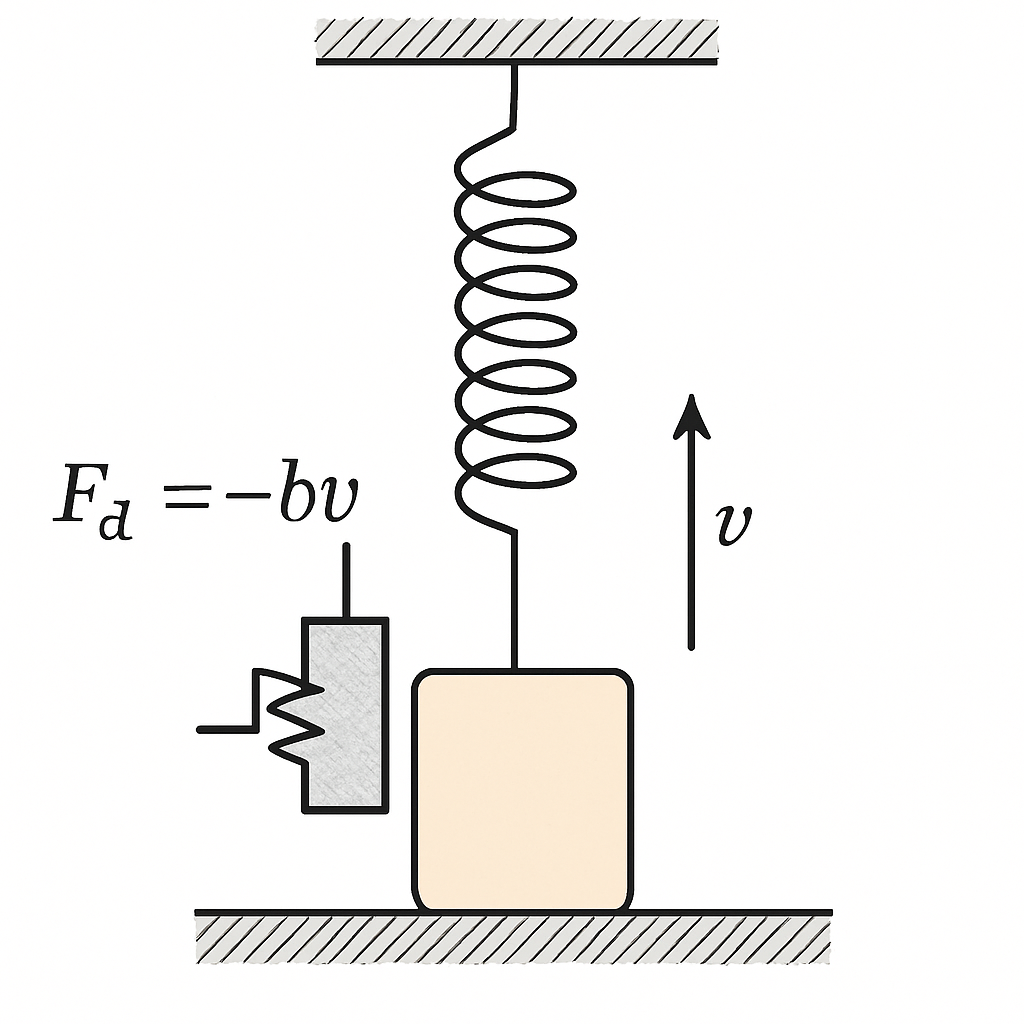
x(t) = A e^(-bt/2m) cos(ω't + φ)
x(t) = A cos(ωt + φ) e^(bt/2m)
x(t) = A sin(ω't + φ) e^(-bt/2)
x(t) = A e^(-bt) sin(ω't + φ)
Correct Answer
Detailed Explanation
The displacement of a damped oscillator with a damping force proportional to velocity is given by x(t) = A e^(-bt/2m) cos(ω't + φ). This is derived from the damping force F_d = -bv, as explained in the NCERT context.
Found an issue with this question?
Related Questions
More from Damped & Forced Oscillations
More from
Assertion (A): The acceleration in simple harmonic motion is always directed towards the mean position. | Reason (R): In simple harmonic motion, accel...
Consider a block attached to a spring on a frictionless surface, as described in the context. If the displacement of the block from the wall is given ...
What is the relationship between the driving frequency and the amplitude of an oscillator in Simple Harmonic Motion?