

NEET 2014 Physics Impulse and Momentum MCQ Question
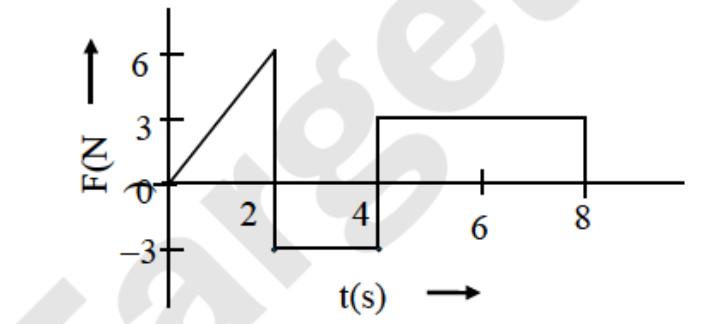
The force F acting on a particle of mass m is indicated by the force-time graph shown below. The change in momentum of the particle over the time interval from zero to 8 s is
24 Ns
20 Ns
12 Ns
6 Ns
Correct Answer
Detailed Explanation
Topic: Impulse and Momentum Difficulty: Medium | Exam: AIPMT 2014
Correct Answer: Option C — 12 Ns
Explanation
According to the impulse-momentum theorem:
Change in momentum = Area under the Force–Time graph.
Divide the graph into three regions:
1. Region 1: Triangle (0–2 s)
2. Region 2: Rectangle (2–4 s)
3. Region 3: Rectangle (4–8 s)
Net change in momentum:
NCERT Concept
Impulse is defined as the product of force and the time interval for which it acts (for constant force). It is equal to the change in linear momentum.
Quick Revision
- Force–time graph → Area = Impulse.
- Area above time axis → Positive.
- Area below time axis → Negative.
- Net impulse = Algebraic sum of all areas.
- SI unit = N s (or kg m/s).
NEET Tip: Always consider the sign of the area while calculating net impulse. Do not add all areas as positive.
Found an issue with this question?
Related Questions
More from Mechanics
The potential energy of a long spring when stretched by 2 cm is U. If the spring is stretched by 8 cm the potential energy stored in it is:
The potential energy of a long spring when stretched by 2 cm is U. If the spring is stretched by 8 cm, potential energy stored in it will be:
Two particles of mass 5 kg and 10 kg respectively are attached to the two ends of a rigid rod of length 1 m with negligible mass. The centre of mass o...