

AIIMS 2005 Physics Resistors MCQ Question
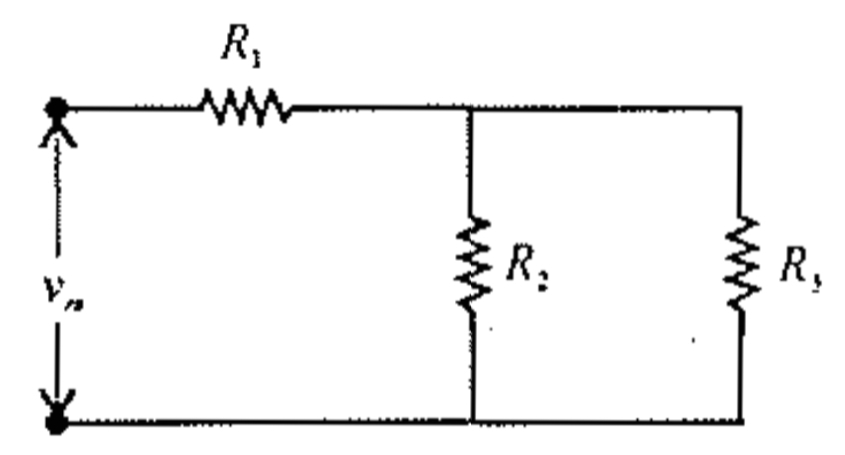
For ensuring dissipation of same energy in all three resistors (R₁, R₂, R₃) connected as shown in figure, their values must be related as
R₁ = R₂ = R₃
R₂ = R₃ and R₁ = 4R₂
R₁ = R₂ and R₃ = 1/4R₂
R₁ = R₂ + R₃
Correct Answer
Detailed Explanation
To understand how to ensure that the same energy is dissipated in all three resistors , , and , we need to analyze the circuit configuration (assumed to be a series or parallel arrangement). In this case, we will discuss the parallel connection as it is commonly implied in such questions concerning equal energy dissipation.
Correct Answer Explanation
The correct answer provided is C) and .
In a parallel circuit, the voltage across each resistor is the same. The power dissipated by each resistor can be calculated using the formula:
Where:
- is the power (or energy per unit time) dissipated by the resistor.
- is the voltage across the resistor.
- is the resistance.
If we denote the common voltage across the resistors as :
-
The power dissipated in is:
-
The power dissipated in is:
-
The power dissipated in is:
For the energy dissipated to be the same in all three resistors, we need:
Substituting the power equations:
Since is common and non-zero, we can simplify these equations to:
Given the relationship from option C, if we set , then:
This implies that and are equal while is one-fourth of their value, thus ensuring that the power dissipated in is equal to that in and when the voltage is the same across all three resistors.
Incorrect Options Explanation
Option A:
This option implies that all three resistances are equal. While this would result in equal power dissipation, it does not satisfy the specific condition that should be one-fourth of either or as per the correct answer. Hence, it is not valid in this context.
Option B: and
In this case, if , then substituting as gives and . The power would be:
Here, is not equal to and , proving that this option does not ensure equal energy dissipation.
Option D:
This option suggests a relationship typically found in series circuits. In a series connection, the power dissipated is not equal across resistors due to different resistances leading to different current through each. Thus, this statement does not apply to our requirement of equal energy dissipation in a parallel connection.
Conclusion
Thus, the correct answer is indeed:
C) and
This relationship ensures that the energy dissipated across all three resistors is equal, adhering to the principles of electrical circuits in parallel arrangements.
Found an issue with this question?
Related Questions
More from 2005
AIDS is caused by HIV that principally infects:
Assertion : The logic gate NOT can be built using diode. Reason : The output voltage and the input voltage of the diode have 180° phase difference.
In a semiconducting material the mobilities of electrons and holes are μₑ and μₕ, respectively. Which of the following is true?