

AIIMS 2019 Chemistry Reactions of Aldehydes and Ketones MCQ Question
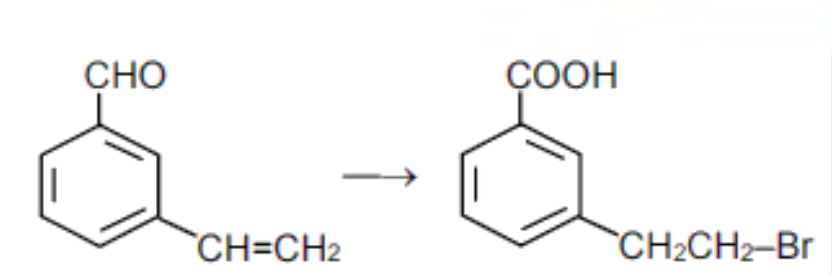
Suitable reagent for following conversion
Correct Answer
Detailed Explanation
The conversion of 3-vinylbenzaldehyde to 3-(2-bromoethyl)benzoic acid requires a Grignard reagent like CH₃MgBr to form an alcohol intermediate, followed by acid workup with H₃O⁺ to yield the corresponding carboxylic acid. The reagents I₂/NaOH can facilitate the formation of the bromoethyl group through a haloform reaction, while H–Br/R₂O₂ is not suitable for this transformation as it does not effectively introduce the bromoethyl moiety in this context. Therefore, option A correctly identifies the necessary reagents for the synthesis pathway.
Found an issue with this question?
Related Questions
More from Organic Chemistry
CH₃OC₂H₅ and (CH₃)₃C – OCH₃ are treated with concentrated acidic iodide. The fragments after reactions obtained are
Arrange the following alkyl halides in decreasing order of the rate of β-elimination reaction with alcoholic KOH.
What happens when a carboxylic acid is treated with lithium aluminium hydride?