

STANDARD Zoology Vertebrates Match the Following Question
Match items in column I with those given in column II
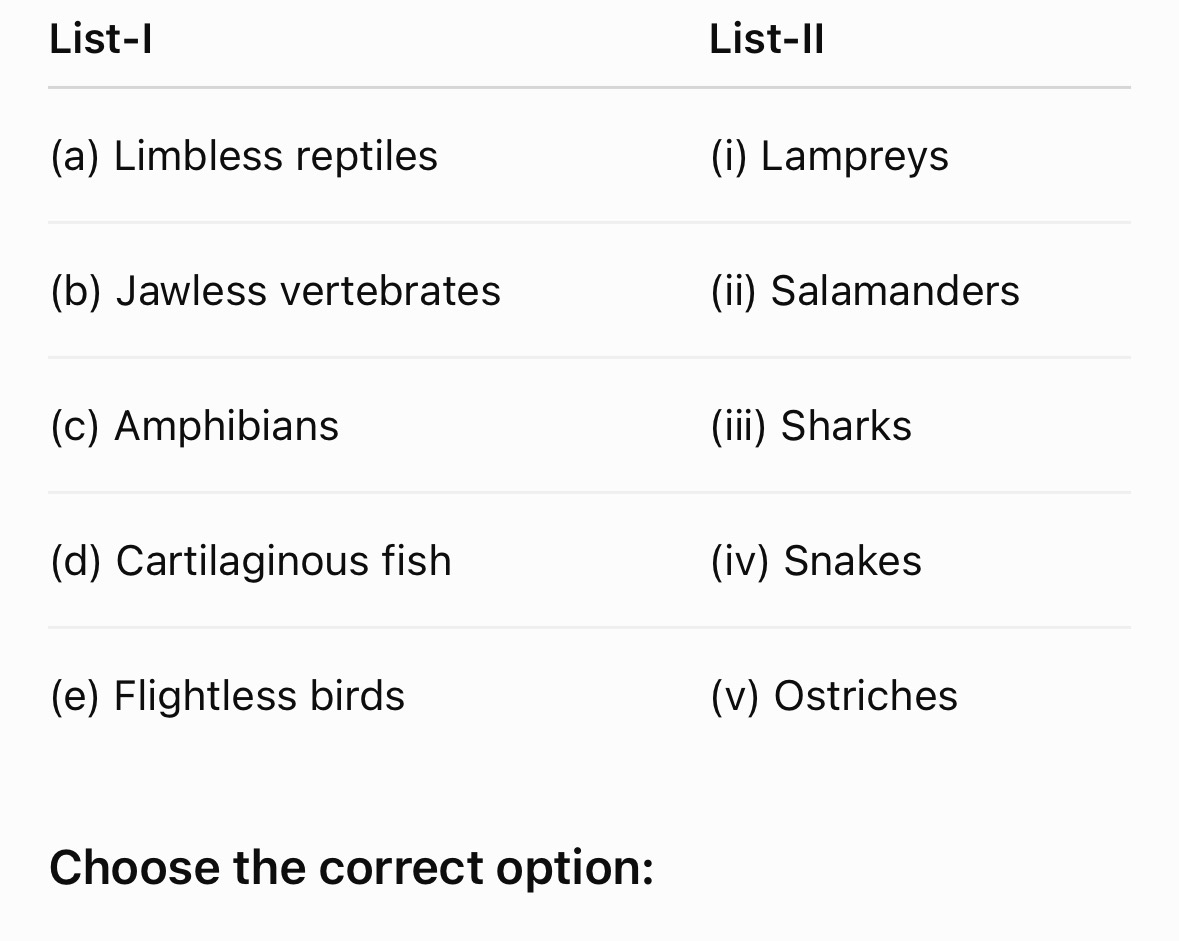
(A)-(i), (B)-(ii), (C)-(iii), (D)-(iv), (E)-(v)
(A)-(ii), (B)-(i), (C)-(iii), (D)-(iv), (E)-(v)
(A)-(iv), (B)-(i), (C)-(ii), (D)-(iii), (E)-(v)
(A)-(v), (B)-(ii), (C)-(iii), (D)-(iv), (E)-(i)
Correct Answer
Detailed Explanation
🧠 Explanation
- Limbless reptiles → Snakes → (a)-(iv)
- Jawless vertebrates → Lampreys → (b)-(i)
- Amphibians → Salamanders → (c)-(ii)
- Cartilaginous fish → Sharks → (d)-(iii)
- Flightless birds → Ostriches → (e)-(v)
Therefore:
✅ Answer: (C)
⚡ Quick Revision: Snakes → Limbless reptiles Lampreys → Jawless vertebrates Salamanders → Amphibians Sharks → Cartilaginous fish Ostrich → Flightless bird
Found an issue with this question?
Related Questions
More from
Which of the following combinations correctly describe characteristics of the phylum Arthropoda?
If an echinoderm's larval stage has bilateral symmetry and it develops into a radially symmetrical adult, how many distinct symmetry patterns are exhi...
What type of body covering do arthropods possess?