

STANDARD Physics Kepler's Laws MCQ Question
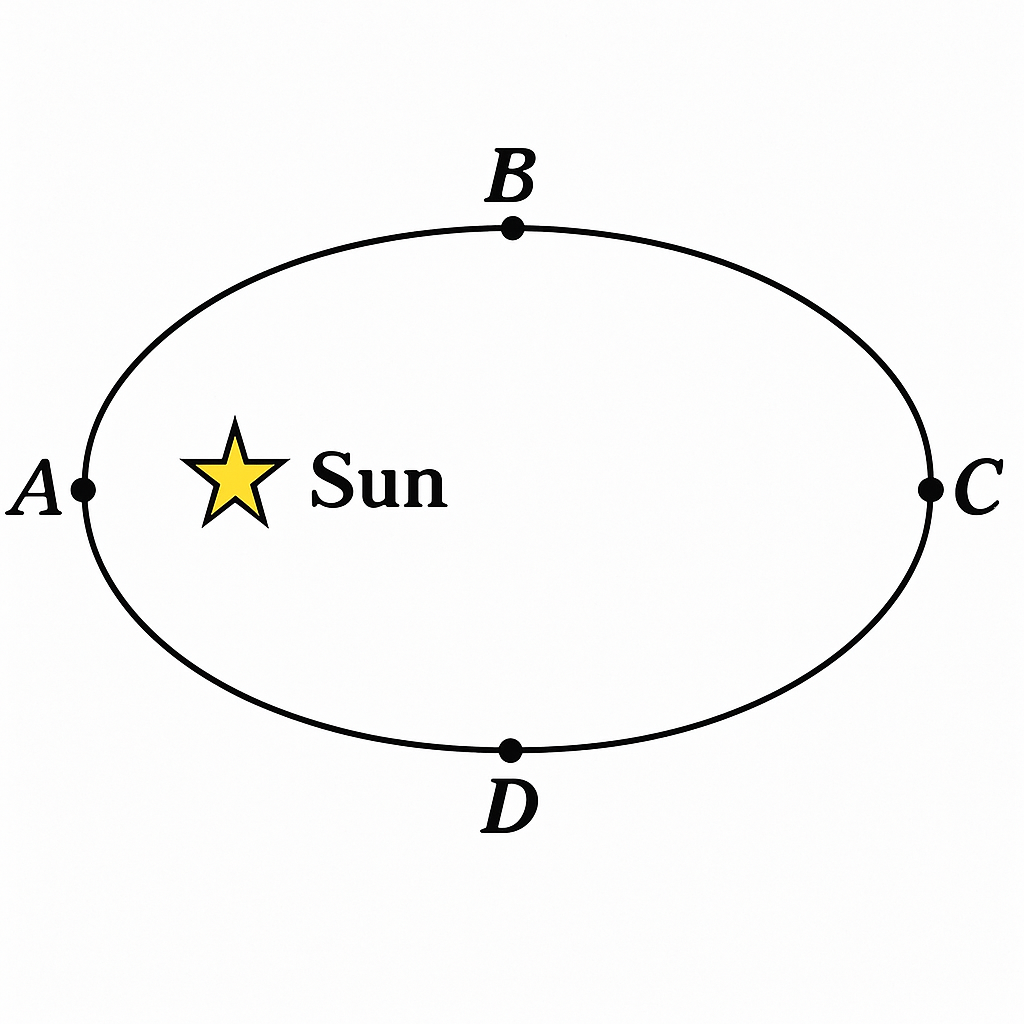
Figure shows elliptical orbit of a planet P about the sun S. The shaded area SCD is twice the shaded area SAB. If t₁ is the time for the planet to move from C to D and t₂ is the time to move from A to B, then
t₁ = t₂
t₁ = 2t₂
t₁ = 4t₂
t₁ > t₂
Correct Answer
Detailed Explanation
The relationship between the two time periods is .
Step-by-Step Explanation
Kepler's Second Law (Law of Equal Areas)A line connecting a planet to the Sun sweeps out equal areas in equal periods of time.
This means the ratio of the area swept to the time taken is always constant:Set up the RatiosLet the smaller area be equal to .
The problem states that area is twice area . So, .Apply the FormulaSubstitute the values into the equation:Simplify the EquationCancel out from both sides:Cross-multiply to solve:
Found an issue with this question?
Related Questions
More from Gravitation
More from
Match Column-I with Column-II. Column-I Column-II (a) Gravitational force between two masses (i) Proportional to the inverse square of dista...
Match Column-I with Column-II. Column-I Column-II (a) Gravitational constant (G) (i) Unity of forces acting on m (b) Principle of superpos...
What happens to the acceleration due to gravity as a point mass moves below the surface of the Earth?