

RE-NEET 2026 Physics Lens Formula MCQ Question
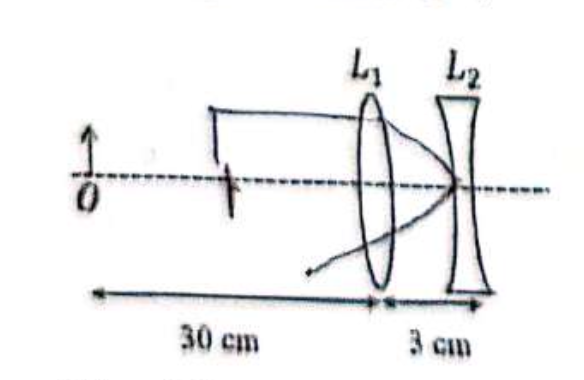
The lens combination as shown in the figure, consists of two lenses, L₁ and L₂, of the focal lengths +10 cm and −10 cm, respectively. The position of the image formed is:
60 cm to the left of the concave lens
30 cm to the right of the concave lens
60 cm to the right of the concave lens
20 cm to the left of the concave lens
Correct Answer
Detailed Explanation
To find the position of the image formed by the lens combination, we first analyze the converging lens with a focal length of . The object is placed to the left of . Using the lens formula:
where and :
Solving gives (to the right of ). This image acts as the object for the concave lens (focal length ), located to the right of , making the object distance for .
Applying the lens formula again:
Solving gives , meaning the image is to the left of . Thus, the correct answer is option A.
The other options fail because they miscalculate the image distances or the sign conventions for the lenses.
Found an issue with this question?
Related Questions
More from 2026
Arrange the following in the correct developmental sequence related to microsporogenesis:
Match List I with List II:
Choose the correct statements regarding cell organelles and their inclusions. A. The endomembrane system includes Golgi complex, endoplasmic reticulu...