

RE-NEET 2026 Physics Electric Potential MCQ Question
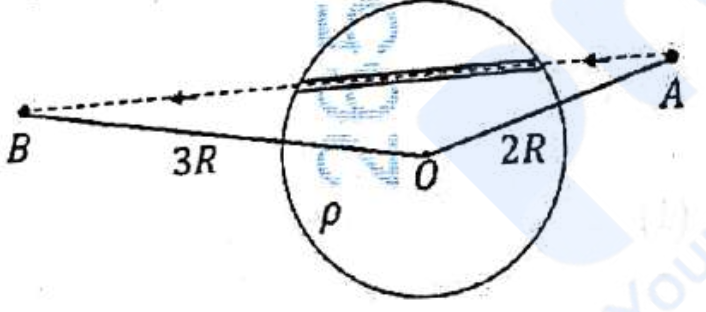
A unit positive point charge is taken slowly through an infinitesimally thin tube that is inside a charged dielectric sphere of radius R, having uniform positive charge density ρ, as shown in the figure. The initial and final positions of the charge are marked by A and B at distances 2R and 3R respectively, from the centre of the sphere. In this process, the magnitude of the total work done on the point charge is . The value of n is ( is the permittivity of vacuum).
6
9
18
2
Correct Answer
Detailed Explanation
To find the work done on a unit positive charge moving from point A to point B, we use the concept of electric potential due to a uniformly charged sphere. The electric field outside the sphere behaves as if all the charge were concentrated at the center.
The potential at a distance from the center of the sphere is given by:
where .
Calculating the potential at points A (2R) and B (3R):
The work done is:
After simplifying, we find:
Thus, . The other options fail because they do not match the derived expression for work done.
Found an issue with this question?
Related Questions
More from 2026
Arrange the following in the correct developmental sequence related to microsporogenesis:
Match List I with List II:
Choose the correct statements regarding cell organelles and their inclusions. A. The endomembrane system includes Golgi complex, endoplasmic reticulu...