

RE-NEET 2026 Physics Photoelectric Effect MCQ Question
A beam of light falls on a metal surface such that photo-electrons are generated. If power of the light source starts to decrease linearly with time t, then variation of the photocurrent I and magnitude of the stopping potential |V| with time is best represented by :
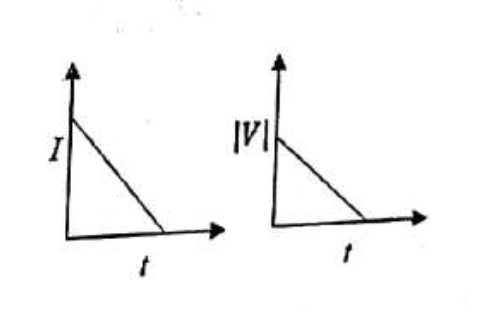
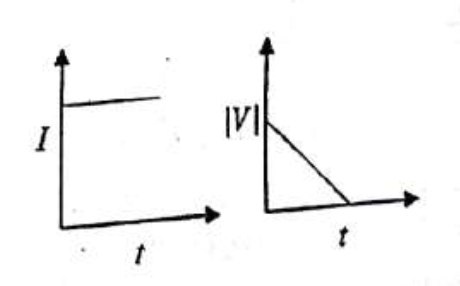
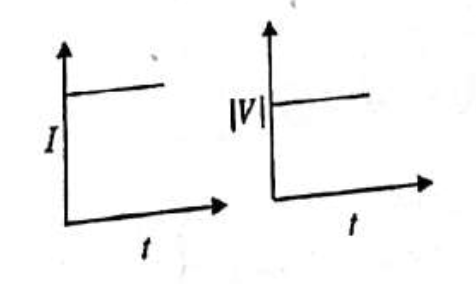
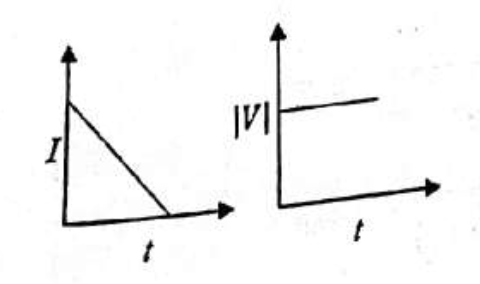
Correct Answer
Detailed Explanation
To understand the behavior of photocurrent and the magnitude of the stopping potential as the power of the light source decreases linearly with time, we must first delve into the fundamentals of the photoelectric effect.
The Photoelectric Effect
When light shines on a metal surface, it can cause the ejection of electrons from that surface. This phenomenon is known as the photoelectric effect. The key concepts include:
- Photon Energy: The energy of each photon is given by
u $$ where is Planck's constant and is the frequency of the light.
-
Work Function: This is the minimum energy required to eject an electron from the surface of the metal, denoted as .
-
Photoelectric Current: The photocurrent is directly proportional to the number of photoelectrons emitted per unit time. Thus, it is also proportional to the intensity (or power) of the light striking the surface.
-
Stopping Potential: The stopping potential is the potential required to stop the fastest emitted photoelectrons. The maximum kinetic energy of the emitted electrons is given by:
u - \phi e |V| = K_{\text{max}} $$ where is the charge of an electron.
Analyzing the Given Situation
In this scenario, we are told that the power of the light source is decreasing linearly over time, expressed as: where is the initial power, is a positive constant, and is time.
-
Photocurrent : Since the photocurrent is proportional to the intensity (or power) of the light, we can express this relationship as: Thus, as the power decreases linearly with time, the photocurrent will also decrease linearly: for some constant .
-
Stopping Potential : The stopping potential depends on the maximum kinetic energy of the emitted electrons. As the power decreases, the number of emitted photoelectrons also decreases, but the energy of each individual photon remains constant (assuming the frequency of light does not change). Therefore, the stopping potential will not change until the intensity drops below a certain threshold, at which point no electrons are emitted.
However, as the current decreases (because fewer electrons are emitted), we observe that remains constant until the power reaches a point where it can no longer release electrons, at which point will drop to zero. Thus, the stopping potential stays constant at a higher value until the threshold power is reached, after which it drops.
Conclusion
In essence, the variation of photocurrent and the magnitude of the stopping potential can be summarized as follows:
- Photocurrent : Decreases linearly with time.
- Stopping Potential : Remains constant until the photocurrent reaches zero, then drops to zero.
Thus, the correct representation of the variation of and over time is best represented by:
Correct Answer: D
Clarification of Other Options
If the options provided included graphical representations, we would find that:
- Option A might suggest an exponential decay, which is incorrect as the photocurrent decreases linearly with power.
- Option B might depict also decreasing linearly, which is incorrect since remains constant until a threshold is reached.
- Option C could misrepresent the relationship between and as being inversely related, which is not the case.
In conclusion, understanding the relationships between power, current, and stopping potential is crucial in analyzing the photoelectric effect and interpreting the question correctly.
Found an issue with this question?
Related Questions
More from 2026
Arrange the following in the correct developmental sequence related to microsporogenesis:
Match List I with List II:
Choose the correct statements regarding cell organelles and their inclusions. A. The endomembrane system includes Golgi complex, endoplasmic reticulu...