

RE-NEET 2026 Physics Temperature Dependence of Resistance MCQ Question
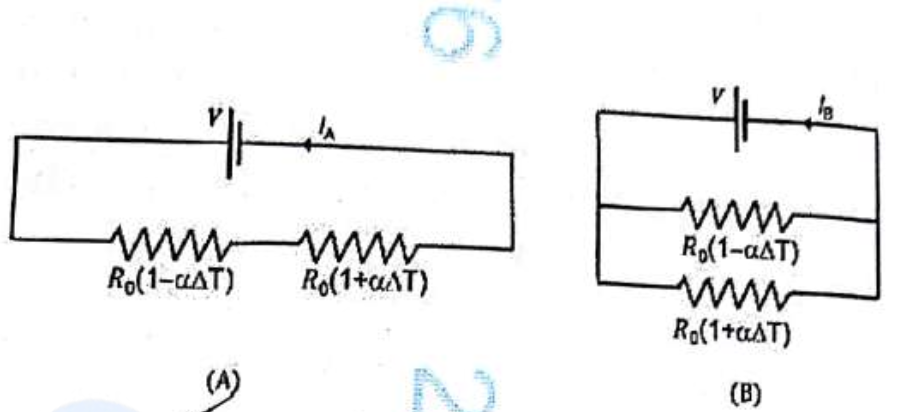
Consider two circuits, (A) and (B), each having two resistors. One of them has a positive temperature coefficient of resistance, +α, while the other one has a negative temperature coefficient, −α, as shown in the figure. The current through these circuits are denoted by I_A and I_B. At initial temperature, the resistance of the two resistors is R₀. As the temperature is increased, the correct option that describes the variation of current in these circuits is:
I_A decreases while I_B increases
I_A increases while I_B decreases
both I_A and I_B remain constant
I_A remains constant while I_B increases
Correct Answer
Detailed Explanation
In circuit (A), the resistors have a positive temperature coefficient (+α), meaning their resistance increases with temperature. Thus, as temperature rises, the resistance becomes . According to Ohm's law, the current is given by:
As increases, decreases.
In circuit (B), the resistors have a negative temperature coefficient (−α), so their resistance decreases with temperature, leading to:
Thus, the current is:
As increases, increases.
Option D is correct because decreases while increases. The other options fail to accurately reflect the behavior of the currents based on the temperature coefficients.
Found an issue with this question?
Related Questions
More from 2026
Arrange the following in the correct developmental sequence related to microsporogenesis:
Match List I with List II:
Choose the correct statements regarding cell organelles and their inclusions. A. The endomembrane system includes Golgi complex, endoplasmic reticulu...