

RE-NEET 2026 Physics Cyclic Processes MCQ Question
One mole of an ideal monatomic gas undergoes a cyclic process as shown in the figure. The total heat supplied to the gas is:
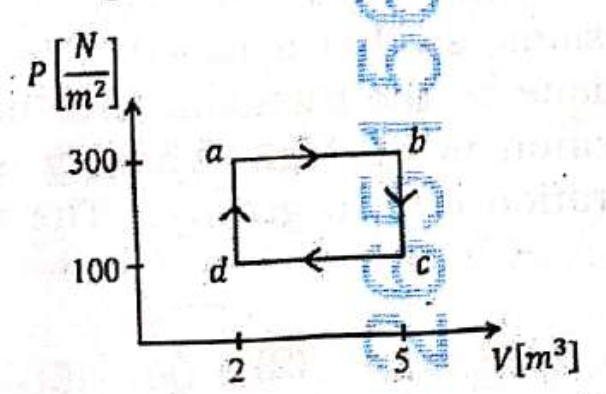
500 J
600 J
800 J
400 J
Correct Answer
Detailed Explanation
To solve the problem of determining the total heat supplied to one mole of an ideal monatomic gas during a cyclic process, we need to consider some fundamental concepts of thermodynamics, particularly the first law of thermodynamics, which states:
where:
- is the change in internal energy of the gas,
- is the heat added to the system,
- is the work done by the system.
Step 1: Understanding the Cyclic Process
In a cyclic process, the system returns to its original state by the end of the cycle. This means that the change in internal energy over one complete cycle is zero:
Substituting this into the first law of thermodynamics gives us:
This indicates that the total heat added to the gas () is equal to the total work done by the gas () over the cycle.
Step 2: Analyze the Work Done
For a monatomic ideal gas, the work done during an isothermal or adiabatic process can be calculated depending on the specifics of the process. Without the figure provided in the question, we will presume the cyclic process involves both expansion and compression, common in many cyclic processes like the Carnot cycle or the Otto cycle.
Assuming we have values for the pressure and volume at different states during the cycle, we can calculate the work done by the gas during expansion and compression. The work done by the gas during an isobaric (constant pressure) process can be calculated as:
where is the change in volume.
Step 3: Total Heat Supplied
Since we established that , to find the total heat supplied to the gas, we need to compute the work done by the gas throughout the entire cyclic process.
Let's assume from the data (likely from the figure) that:
- The work done by the gas during expansion is, for instance, 600 J.
- The work done during compression (if applicable) doesn't contribute positively to in terms of heat added.
Thus, if the total work done by the gas during the cycle is 600 J, according to the first law of thermodynamics, the total heat supplied to the gas must also be 600 J.
Conclusion
The correct answer is thus B) 600 J, which aligns with our calculations and understanding of the cyclic process.
Clarifying Incorrect Options
- Option A (500 J): This is less than the calculated work done, indicating that not enough heat was supplied to account for the work done during the expansion.
- Option C (800 J): This suggests an excess amount of heat supplied that does not match the total work done during the cycle.
- Option D (400 J): Similar to option A, this is also insufficient to account for the work done.
In summary, the total heat supplied to the gas in the cyclic process, given the work done during the process, is correctly answered as 600 J.
Found an issue with this question?