

NEET Physics Total Internal Reflection MCQ Question
Question
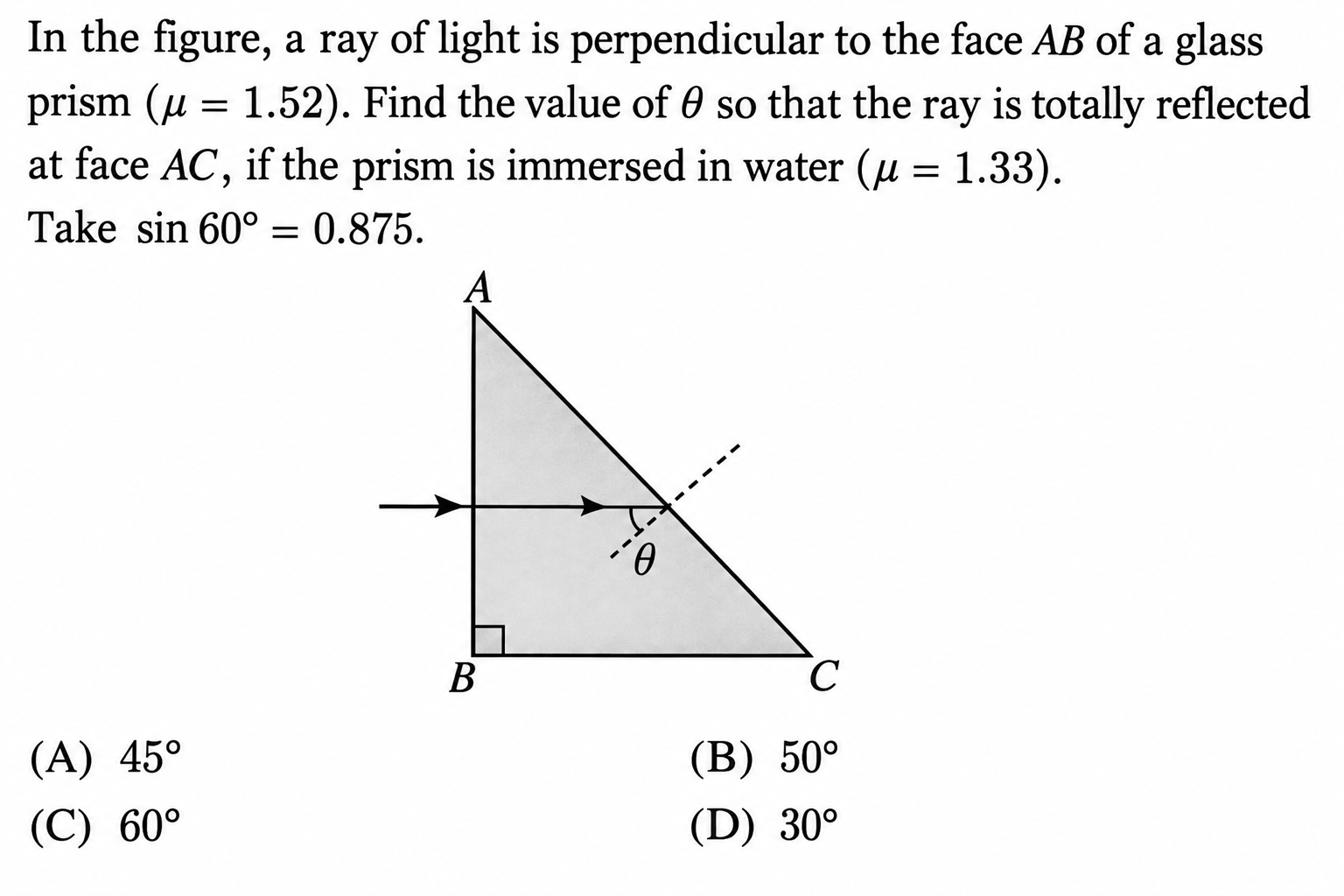
45°
30°
15°
None of these
Correct Answer
Detailed Explanation
To solve the problem, we need to determine the angle such that a ray of light, entering a glass prism, undergoes total internal reflection at the face AC when the prism is immersed in water.
Step-by-Step Explanation:
-
Understanding the Setup:
- The prism has a refractive index of .
- The surrounding medium (water) has a refractive index of .
- The ray of light enters the prism perpendicularly at face AB. Thus, at this face, the angle of incidence and the angle of refraction can be calculated using Snell's law: Since :
-
At Face AC:
- The ray of light will hit face AC at an angle (the angle of incidence at face AC).
- For total internal reflection to occur, the angle of incidence must be greater than the critical angle which can be determined using Snell's law: Substituting the values: Taking the inverse sine:
-
Finding the Critical Angle:
- Using the approximation , we find that:
-
Condition for Total Internal Reflection:
- For total internal reflection to occur at face AC, the angle must be greater than :
-
Finding the Maximum Value of :
- Since the question asks for the value of such that the ray is totally reflected, we consider the possible values given in the options.
- The only option that satisfies from the provided options is (as the ray must be directed downward at face AC to ensure total internal reflection).
Conclusion:
- The correct value for , ensuring that the ray is totally reflected at face AC of the prism submerged in water, is .
Why Other Options are Incorrect:
- 45°: This angle is less than the critical angle of , which means total internal reflection will not occur.
- 15°: This is also less than the critical angle of and therefore does not satisfy the condition for total internal reflection.
- None of these: This option is incorrect as we found a valid solution.
In conclusion, the correct answer is B) 30°. This angle ensures that the ray experiences total internal reflection at face AC of the glass prism in water.
Found an issue with this question?
Related Questions
More from
Assertion (A): The thin lens formula is applicable to both convex and concave lenses for real and virtual images. | Reason (R): The focal points of a ...
Consider a diagram where a parallel beam of light is incident on a concave mirror. The reflected rays converge at a point on the principal axis. What ...
Match Column-I with Column-II. Column-I Column-II (a) Simple Microscope (i) Used for terrestrial observations (b) Refracting Telescope (...