

NEET Physics de Broglie Wavelength MCQ Question
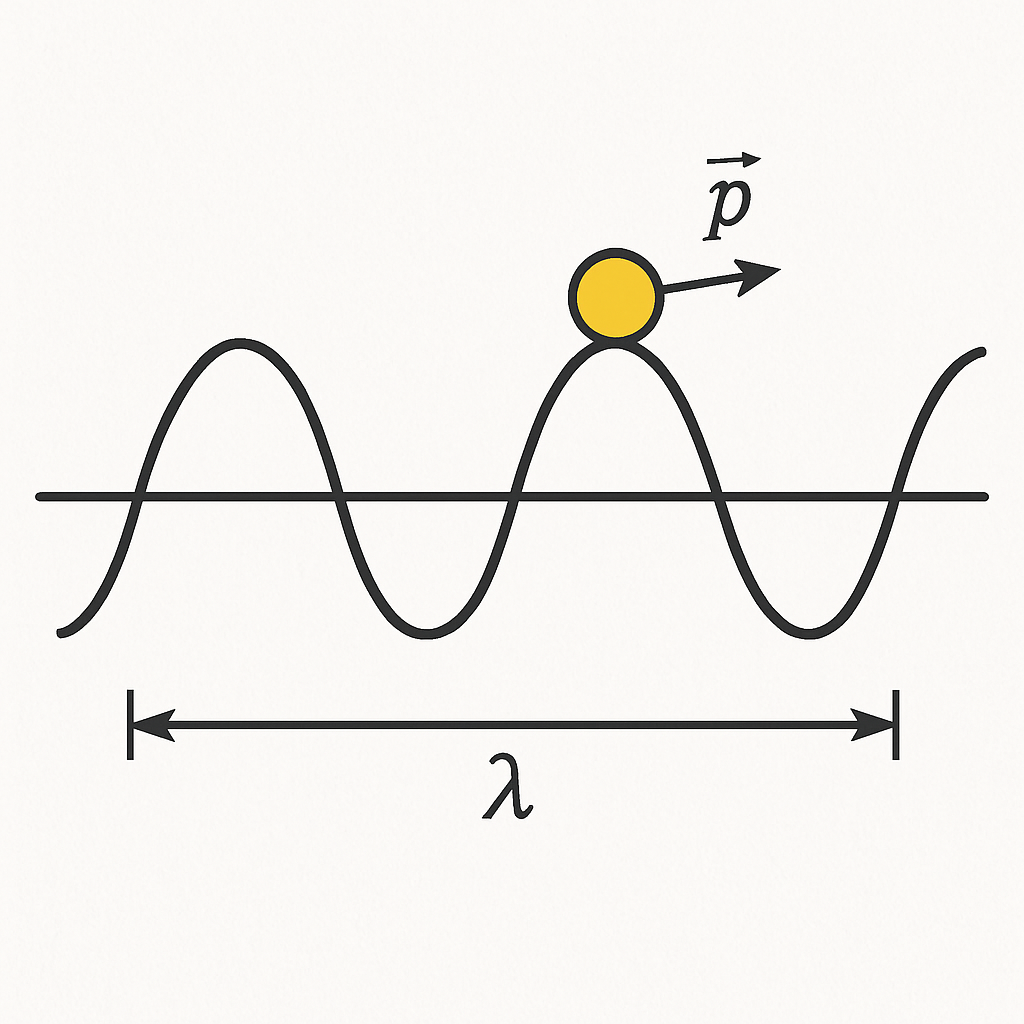
Imagine a diagram showing a wave-like pattern associated with a particle moving at a specific velocity. The particle's momentum is labeled as and its de Broglie wavelength as . Which of the following correctly describes the relationship depicted between the particle's momentum and its de Broglie wavelength?
The de Broglie wavelength is directly proportional to the particle's momentum.
The de Broglie wavelength is inversely proportional to the particle's momentum.
The de Broglie wavelength remains constant irrespective of the particle's momentum.
The de Broglie wavelength is independent of both the particle's momentum and velocity.
Correct Answer
Detailed Explanation
The de Broglie wavelength is given by , indicating an inverse relationship with momentum . This is noted in the NCERT context where .
Found an issue with this question?
Related Questions
More from de Broglie Wavelength
Match Column-I with Column-II. Column-I Column-II (a) de Broglie wavelength of an electron (i) 6.63 × 10^-34 J s (b) de Broglie wavelength...
What is the de Broglie wavelength of a particle with mass 0.15 kg moving at a speed of 30.0 m/s?
Which of the following statements about de Broglie wavelength is correct?
More from
Assertion (A): The Davisson-Germer experiment demonstrated the wave nature of electrons. | Reason (R): The experiment showed that electrons exhibit in...
Assertion (A): The wave nature of particles like electrons is significant due to their small masses and momenta. | Reason (R): Macroscopic objects do ...