NEET Physics de Broglie Wavelength MCQ Question
Consider a diagram showing an electron beam being diffracted by a crystal lattice, similar to the Davisson-Germer experiment setup. Which of the following best explains the occurrence of diffraction in terms of de Broglie wavelength?
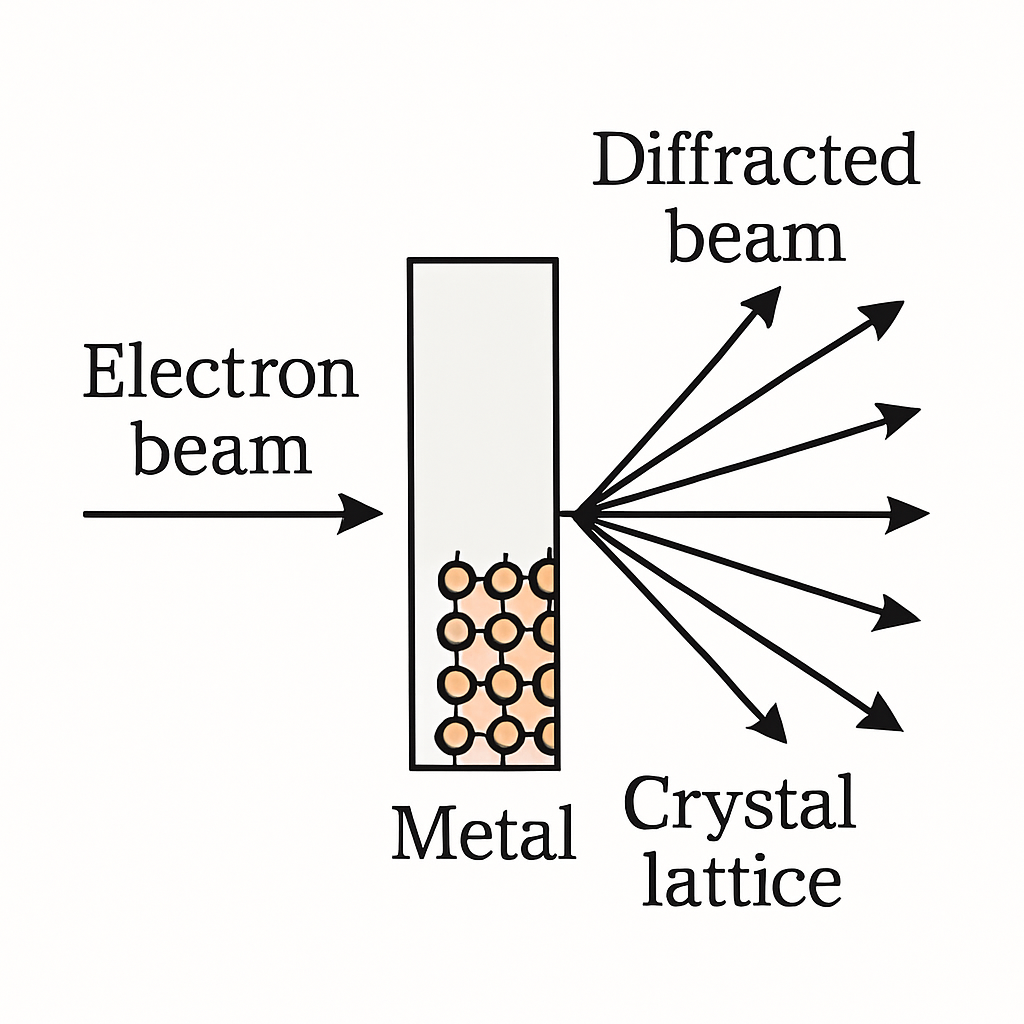
Electrons exhibit wave properties, with a wavelength determined by their momentum.
Electrons lose energy upon striking the crystal, resulting in diffraction.
Diffraction occurs due to the electromagnetic field around the electrons.
The electrons' mass causes them to behave like classical waves.
Correct Answer
Detailed Explanation
Diffraction of electrons is explained by their wave properties, as described by the de Broglie wavelength, which is inversely proportional to their momentum.
Found an issue with this question?
Related Questions
More from de Broglie Wavelength
Match Column-I with Column-II. Column-I Column-II (a) de Broglie wavelength of an electron (i) 6.63 × 10^-34 J s (b) de Broglie wavelength...
What is the de Broglie wavelength of a particle with mass 0.15 kg moving at a speed of 30.0 m/s?
Which of the following statements about de Broglie wavelength is correct?