

NEET Physics Kirchhoff's Laws MCQ Question
Consider a circuit consisting of two loops with three resistors and and two batteries with emfs and . If Kirchhoff's loop rule is applied to both loops, what is the correct expression for the loop containing and ?
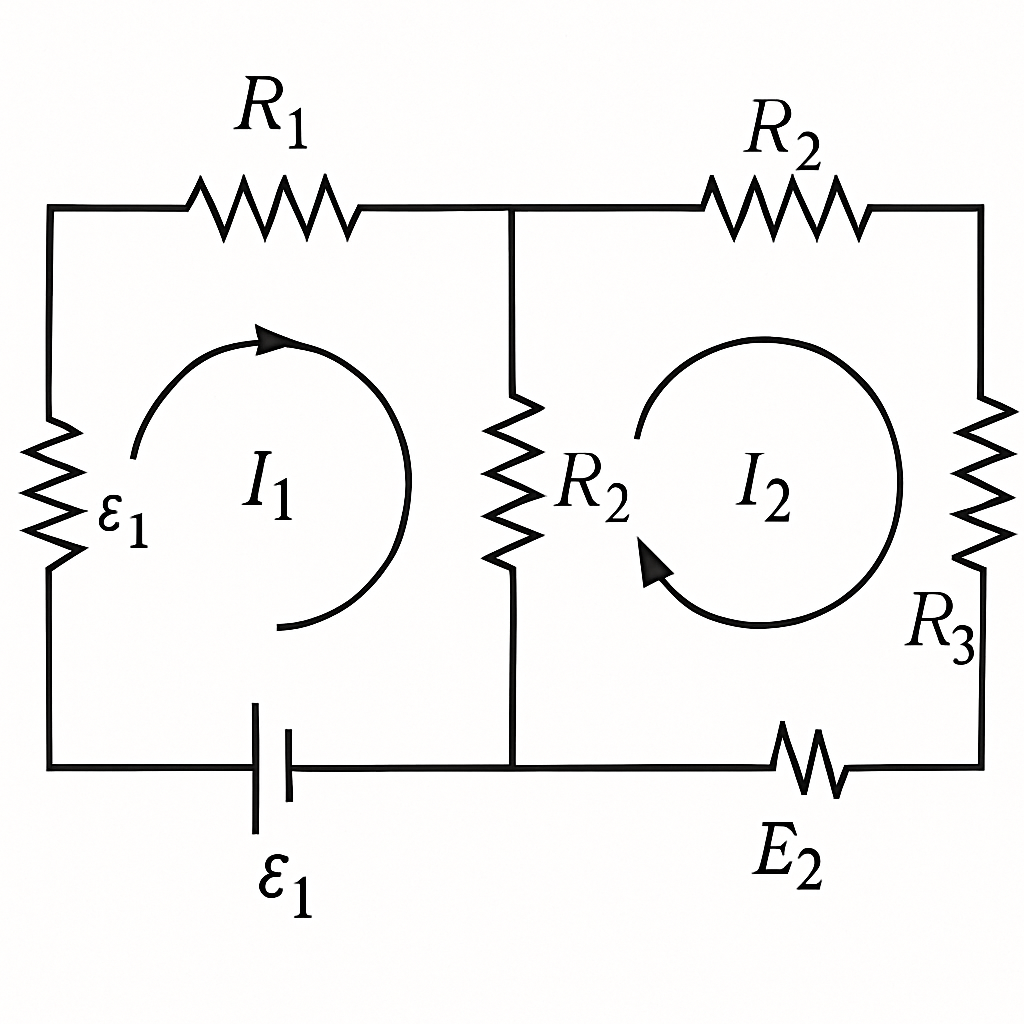
Correct Answer
Detailed Explanation
Kirchhoff's loop rule states that the algebraic sum of emfs and potential drops (products of current and resistance) in any closed loop is zero. In this loop, the potential difference across and are and respectively, and the emfs and are subtracted according to their orientation.
Found an issue with this question?
Related Questions
More from
Consider a diagram showing a rectangular slab of length \( l \) and area of cross-section \( A \). If the resistance \( R \) of the slab is given by t...
Assertion (A): The equivalent emf of two cells in parallel is the sum of their emfs divided by the sum of their internal resistances. | Reason (R): Th...
Which of the following statements best defines when a conducting material obeys Ohm's law?