

NEET Physics Work-Energy Theorem MCQ Question
Consider a block of mass m moving on a smooth horizontal table with an initial speed v_i. If a force F(x) acts on the block, which depends inversely on the position x, how is the work done by this force related to the change in kinetic energy of the block?
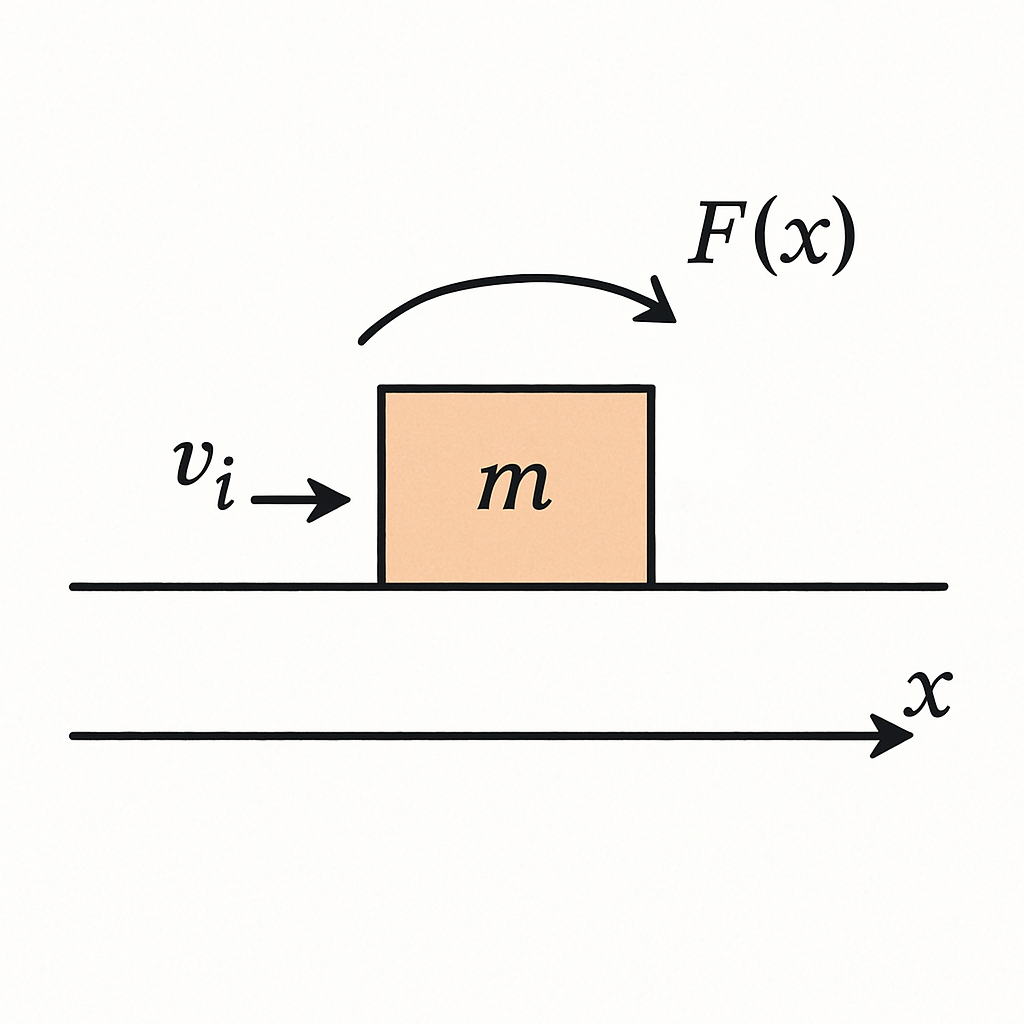
The work done by the force equals the change in kinetic energy, which can be expressed as an integral from x_i to x_f of F(x) dx.
The work done by the force is independent of the change in kinetic energy and depends only on the initial speed v_i.
The work done by the force equals the change in kinetic energy and is directly proportional to the initial speed squared.
The work done by the force is zero because the force is inversely proportional to x.
Correct Answer
Detailed Explanation
The work-energy theorem states that the work done by a force is equal to the change in kinetic energy, as shown by integrating F(x) dx from initial to final position.
Found an issue with this question?
Related Questions
More from Work-Energy Theorem
More from
Which of the following statements about power is correct?
Assertion (A): The dot product of two vectors is zero when the vectors are perpendicular. | Reason (R): The scalar product of two vectors is the produ...
A particle acted upon by constant forces 4î + ĵ − 3k̂ and 3î + ĵ − k̂ is displaced from the point î + 2ĵ + k̂ to point 5î + 4ĵ + k̂. The total...