NEET Physics Transverse & Longitudinal Waves MCQ Question
Consider a diagram showing two sinusoidal waves on the same string with the same amplitude and frequency, differing in phase by a phase constant . Which of the following best describes the resultant wave according to the principle of superposition?
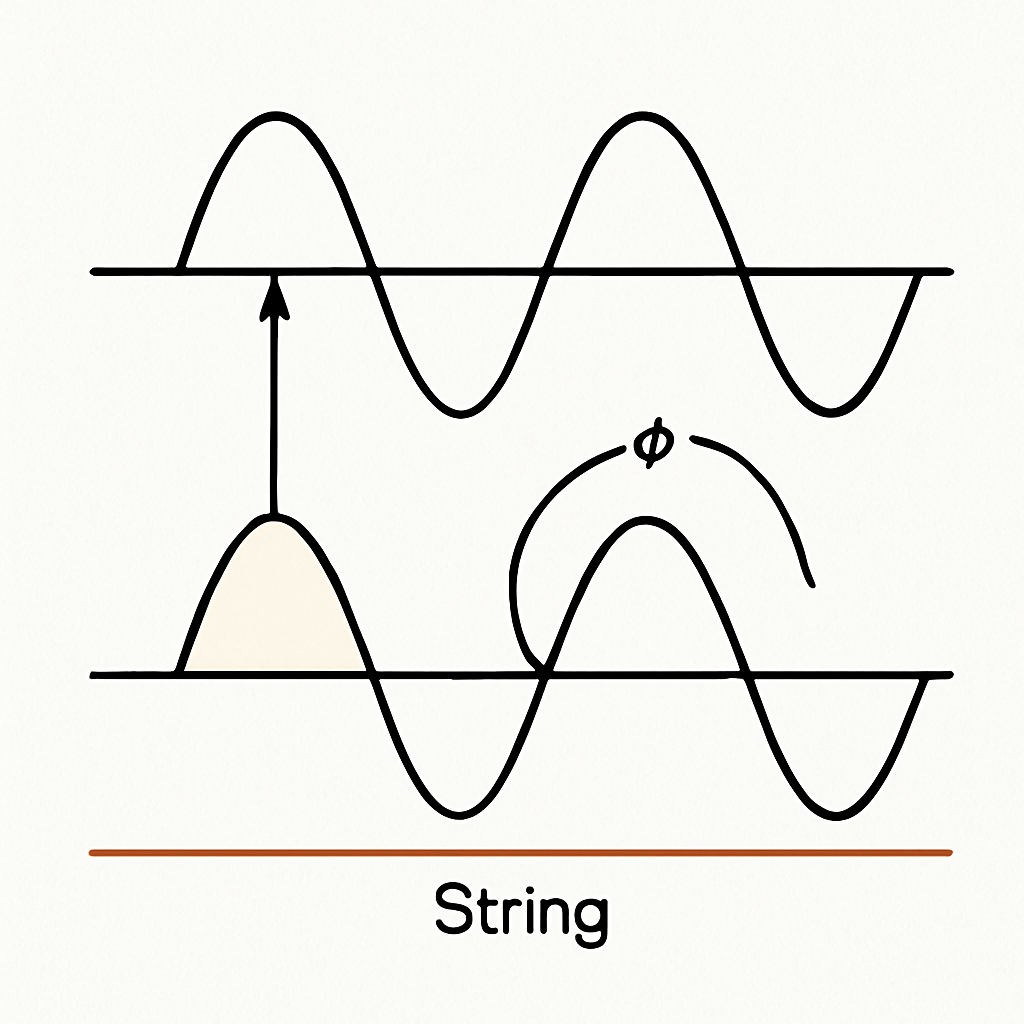
The resultant wave has the same frequency as the original waves.
The resultant wave has double the frequency of the original waves.
The resultant wave has zero amplitude everywhere.
The resultant wave has half the wavelength of the original waves.
Correct Answer
Detailed Explanation
According to the principle of superposition, two sinusoidal waves with the same amplitude and frequency, differing only in phase, result in a single wave of the same frequency.
Found an issue with this question?
Related Questions
More from Transverse & Longitudinal Waves
A diagram shows a wave in a solid medium with particles oscillating perpendicular to the direction of wave propagation. Which type of wave is being de...
Which of the following combinations about transverse and longitudinal waves is correct?
A diagram shows a wave traveling along a stretched string. The particle motion is depicted perpendicular to the direction of wave propagation. Which t...
More from
What does the variable 'a' represent in the wave motion equation y(x, t) = a sin(kx - ωt)?
A diagram depicts a sinusoidal wave traveling along the positive x-axis. The wave is described by the equation y(x, t) = a sin(kx - ωt + φ). What does...
Assertion (A): The wavelength of a wave is the distance between two consecutive points having the same phase. | Reason (R): In a sinusoidal wave, the ...