

NEET Physics Isothermal & Adiabatic Processes MCQ Question
Consider a diagram showing an adiabatic process involving an ideal gas enclosed in a cylinder with a movable piston, separated from the surroundings by an adiabatic wall. If the gas transitions from an initial state A (temperature T_A) to a final state B (temperature T_B), which of the following correctly describes the energy changes in the system?
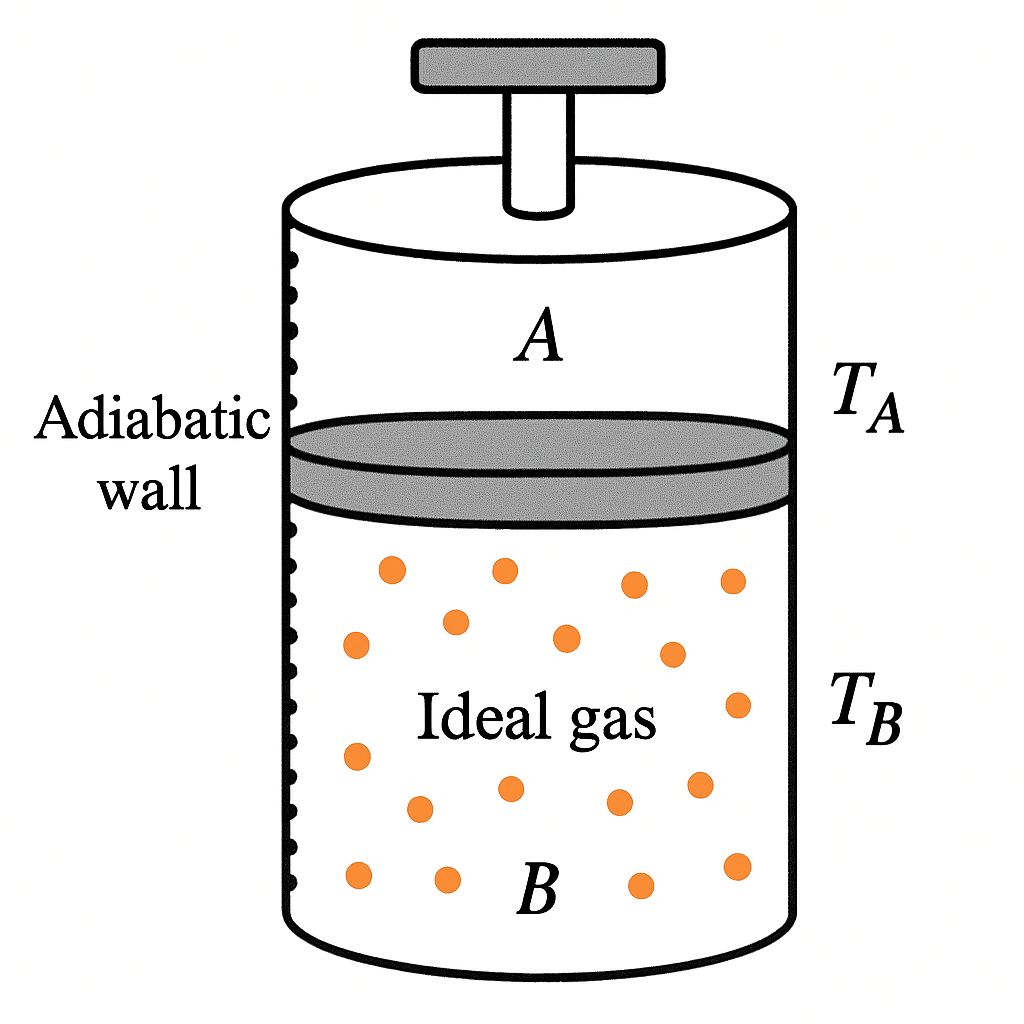
The internal energy change (ΔU) is equal to the work done (w_ad) on the system.
The internal energy change (ΔU) is zero because no heat is transferred.
The work done (w_ad) is zero because the adiabatic wall prevents energy transfer.
The internal energy change (ΔU) equals the heat transferred (q) since q = 0.
Correct Answer
Detailed Explanation
In an adiabatic process, there is no heat transfer (q = 0), so the change in internal energy (ΔU) is equal to the work done (w_ad) on the system. This is consistent with the relation ΔU = w_ad.
Found an issue with this question?
Related Questions
More from Isothermal & Adiabatic Processes
For an adiabatic expansion of an ideal gas, if the initial internal energy is 500 J and the work done on the system is -200 J, what is the final inter...
For an isothermal expansion of an ideal gas into vacuum at 25°C, if the initial volume is 2 liters and the final volume is 10 liters, what is the chan...
More from
What is the enthalpy change associated with the atomization of dihydrogen (H2)?
For a strongly endothermic reaction, what is the expected value of the equilibrium constant K?
Which thermodynamic property directly decides the spontaneity of a process in a system?