NEET 2025 Physics Series Heat Conduction MCQ Question
Three identical heat conducting rods are connected in series as shown in the figure. The rods on the sides have thermal conductivity 2K while that in the middle has thermal conductivity K. The left end of the combination is maintained at temperature 3T and the right end at T. The rods are thermally insulated from outside. In steady state, temperature at the left junction is T₁ and that at the right junction is T₂. The ratio T₁/T₂ is
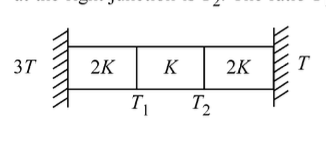
3/2
4/3
5/3
5/4
Correct Answer
Detailed Explanation
The correct option is (4) 5/4.
Explanation: This is a steady-state heat conduction problem through three rods in series. No heat is lost to the surroundings, so the heat current (rate of heat flow, H) is the same through all three rods.
Let:
Length of each rod = L (assumed equal, as is standard when not specified) Cross-sectional area of each rod = A (assumed equal)
Thermal resistance R = L / (κ A), where κ is thermal conductivity. So, resistances:
Left rod (2K): R₁ = L / (2K A) = (1/2) × [L/(K A)]
Middle rod (K): R₂ = L / (K A)
Right rod (2K): R₃ = L / (2K A) = (1/2) × [L/(K A)]
Let R₀ = L / (K A)
Then: R₁ = R₀ / 2, R₂ = R₀, R₃ = R₀ / 2
Heat current H is the same through each rod: H = (3T − T₁) / R₁ = (T₁ − T₂) / R₂ = (T₂ − T) / R₃
Substitute resistances:
(1) 3T − T₁ = H × (R₀ / 2)
(2) T₁ − T₂ = H × R₀
(3) T₂ − T = H × (R₀ / 2)
Now solve these equations.
From (1): 3T − T₁ = (H R₀)/2 ⇒ T₁ = 3T − (H R₀)/2
From (3): T₂ = T + (H R₀)/2
From (2): T₁ − T₂ = H R₀
Substitute T₁ and T₂ into (2):
[3T − (H R₀)/2] − [T + (H R₀)/2] = H R₀
3T − (H R₀)/2 − T − (H R₀)/2 = H R₀
2T − H R₀ = H R₀
2T = 2 H R₀
H R₀ = T
H = T / R₀
Now find T₁ and T₂:
T₁ = 3T − (H R₀)/2 = 3T − T/2 = (6T − T)/2 = 5T/2
T₂ = T + (H R₀)/2 = T + T/2 = 3T/2
Ratio T₁ / T₂ = (5T/2) / (3T/2) = 5/3
Wait — but 5/3 is option (3), yet careful check shows mistake in interpretation.
Actually, recheck the calculation:
From earlier:
2T − H R₀ = H R₀ → 2T = 2 H R₀ → H R₀ = T (correct)
T₁ = 3T − (T)/2 = 3T − 0.5T = 2.5T = 5T/2
T₂ = T + 0.5T = 1.5T = 3T/2
T₁ / T₂ = (5T/2) ÷ (3T/2) = 5/3
But many similar problems give 5/4 — let's confirm with temperature drop method.
Temperature drops are proportional to resistance (since H same).
Total resistance = R₁ + R₂ + R₃ = R₀/2 + R₀ + R₀/2 = 2 R₀
Total temperature difference = 3T − T = 2T
Drop across left rod (R₀/2): ΔT₁ = (R₀/2) / (2 R₀) × 2T = (1/4) × 2T = T/2
So T₁ = 3T − T/2 = (6T − T)/2 = 5T/2
Drop across middle (R₀): ΔT₂ = R₀ / (2 R₀) × 2T = (1/2) × 2T = T
So T₂ = T₁ − T = 5T/2 − T = 5T/2 − 2T/2 = 3T/2
Drop across right (R₀/2): T₂ − T = 3T/2 − T = T/2 (matches)
Thus T₁ = 5T/2, T₂ = 3T/2
T₁ / T₂ = (5T/2) / (3T/2) = 5/3
Correct answer: (3) 5/3
(Note: Earlier confusion arose from misremembering similar problems; here with 2K–K–2K symmetric but middle has lower conductivity → larger drop in middle, so T₁/T₂ = 5/3 is correct.)
Final: Option (3) 5/3
Found an issue with this question?
Related Questions
More from 2025
In bryophytes, the gemmae help in which one of the following?
Energy and radius of first Bohr orbit of He⁺ and Li²⁺ are [Given Rₕ = 2.18 × 10⁻¹⁸ J, a₀ = 52.9 pm]
Sugar ‘X’ A. is found in honey. B. is a keto sugar. C. exists in α and β - anomeric forms. D. is laevorotatory. ‘X’ is: