

NEET Physics Distance & Displacement MCQ Question
Consider a velocity-time graph for an object moving with uniform acceleration. If the area under the curve from time t=0 to t=T represents the displacement of the object, what can be inferred about the relationship between the initial velocity v0, final velocity v, and the displacement x?
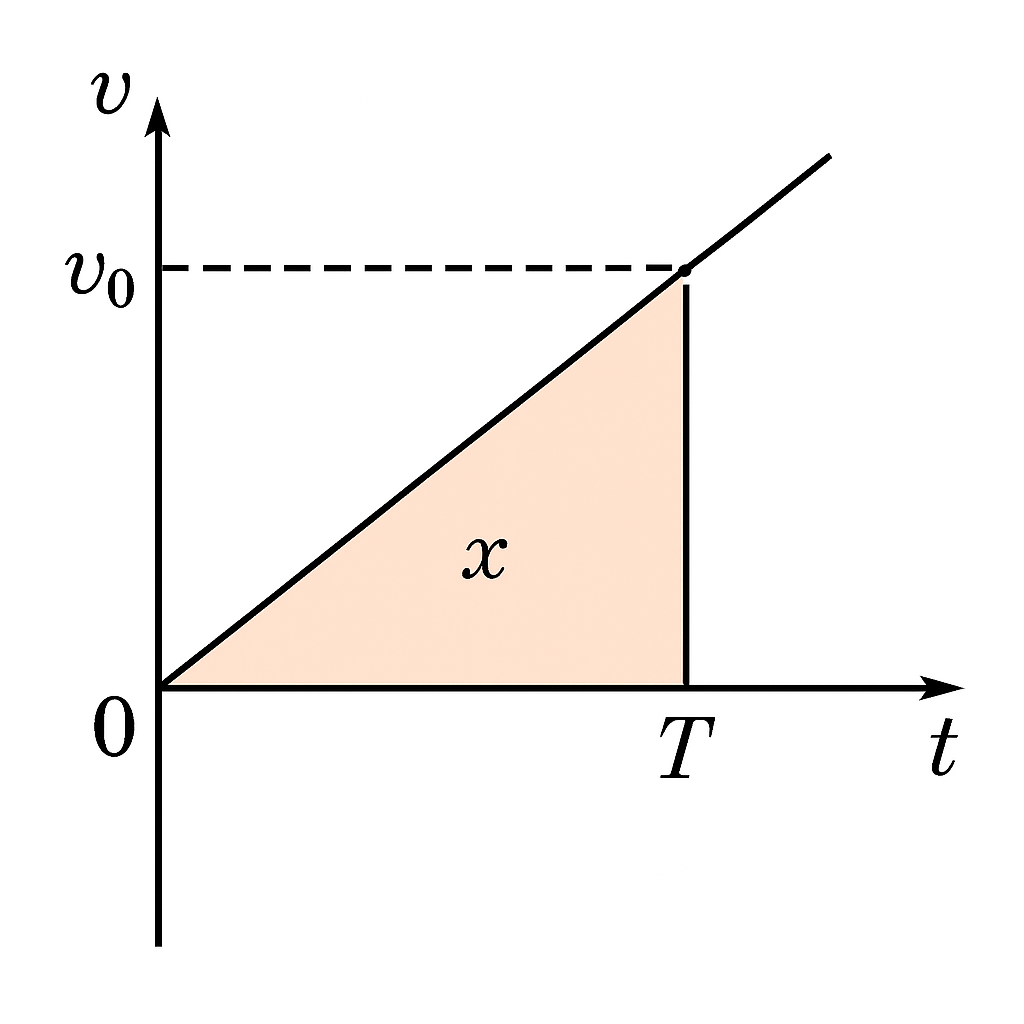
The displacement x is equal to the area of a triangle formed by v0, v, and T.
The displacement x is equal to the area of a rectangle formed by v0 and T.
The displacement x is equal to the arithmetic average of v0 and v multiplied by time T.
The displacement x is solely determined by the final velocity v and time T.
Correct Answer
Detailed Explanation
To analyze the relationship between initial velocity , final velocity , and displacement in the context of uniform acceleration, we can start by understanding the velocity-time graph and the area under the curve.
Explanation of the Correct Answer (C)
In the case of uniform acceleration, the velocity of the object changes linearly over time. The velocity-time graph will therefore be a straight line. The initial velocity is represented by at and the final velocity at time .
The area under the velocity-time graph from to gives us the total displacement of the object:
Since the graph is a trapezium (or a triangle if initial velocity is zero), we can find the area using the formula for the area of a trapezoid:
Where:
- (initial velocity)
- (final velocity)
- (time duration)
Thus, the displacement can be expressed as:
This formula shows that the displacement is equal to the arithmetic average of the initial and final velocities multiplied by the time . This confirms that option C is correct.
Clarification of Other Options
Option A: "The displacement is equal to the area of a triangle formed by , , and ."
This option is incorrect because the area under the curve is not just a triangle; it is a trapezoid (or a combination of a rectangle and triangle if is not zero).
Option B: "The displacement is equal to the area of a rectangle formed by and ."
This is incorrect because the rectangle would only represent the displacement if the velocity were constant at for the entire time . However, in the case of uniform acceleration, the velocity changes from to .
Option D: "The displacement is solely determined by the final velocity and time ."
This is incorrect because displacement also depends on the initial velocity . The effect of both initial and final velocities is necessary to calculate accurate displacement under uniform acceleration.
Summary of Key Formulas
- Displacement under uniform acceleration:
- Final velocity in terms of initial velocity, acceleration, and time:
- Average velocity under uniform acceleration:
Found an issue with this question?
Related Questions
More from
A ball is thrown vertically upward with an initial velocity of 20 m/s. If the acceleration due to gravity is -10 m/s², what is the maximum height it r...
Assertion (A): For uniform motion, the acceleration is zero. | Reason (R): The velocity-time graph for uniform motion is a straight line parallel to t...
A car travels along a straight road with a uniform acceleration. If its initial velocity is 10 m/s and it reaches a velocity of 30 m/s in 5 seconds, w...