NEET 2025 Physics Circular Motion MCQ Question
A bob of heavy mass m is suspended by a light string of length l. The bob is given a horizontal velocity v₀ as shown in figure. If the string gets slack at some point P making an angle θ from the horizontal, the ratio of the speed v of the bob at point P to its initial speed v₀ is:
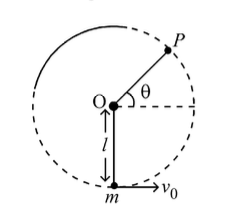
(sin θ)¹/²
(1 / (2 + 3 sin θ))¹/²
(cos θ / (2 + 3 sin θ))¹/²
(sin θ / (2 + 3 sin θ))¹/²
Correct Answer
Detailed Explanation
To solve the problem of finding the ratio of the speed of the bob at point to its initial speed , we can use two key principles: the condition for the string to go slack and the conservation of mechanical energy.
Step 1: Condition for the String to Go Slack
At point , the string becomes slack. This means that the tension in the string is zero. The only force providing the necessary centripetal force is the component of the bob's weight acting toward the center of the circular path.
-
The weight of the bob is given by , where is the mass of the bob and is the acceleration due to gravity.
-
The component of weight acting toward the center at angle is .
-
The centripetal force required to keep the bob moving in a circular path is provided by this component:
-
Rearranging gives:
Step 2: Conservation of Mechanical Energy
Next, we apply the principle of conservation of mechanical energy between the initial position (bottom of the swing) and point .
-
Initial Energy (at the bottom): The potential energy at the bottom can be considered zero, and the kinetic energy is:
-
Energy at Point : At point , the bob has kinetic energy and potential energy. The potential energy is determined by the height of the bob above the reference point (the bottom):
-
The height at point is given by:
-
Therefore, the potential energy at point is:
-
The kinetic energy at point is:
Thus, the total energy at point is:
-
-
Setting Initial Energy Equal to Final Energy:
From conservation of energy, we have:
So,
Dividing through by and multiplying by 2 gives:
Step 3: Finding the Ratio
Now we substitute (from Step 1) into the energy equation:
-
Substituting gives:
Simplifying this:
-
Now, to find the ratio :
-
Taking the square root gives:
Conclusion
The correct answer is:
Option D: (sin θ / (2 + 3 sin θ))¹/²
Found an issue with this question?