

NEET 2022 Physics Fluid Dynamics MCQ Question
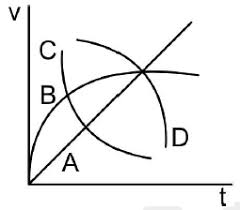
A spherical ball is dropped in a long column of a highly viscous liquid. The curve in the graph shown, which represents the speed of the ball (v) as a function of time (t) is:
C
D
A
B
Correct Answer
Detailed Explanation
✅ Correct answer: D — B
NCERT states that for a sphere falling through a viscous medium:
-
Initially, it accelerates due to gravity.
-
As velocity increases, the retarding viscous force increases because
-
Eventually, viscous force + buoyant force = gravitational force.
-
Net force becomes zero, so acceleration becomes zero.
-
The sphere then moves with constant terminal velocity. (Sathee)
Therefore the curve must:
That corresponds to curve B in your diagram.
❌ Why other options are wrong
- A: Straight line → constant acceleration. ❌ But acceleration decreases as viscous force increases.
- C: Velocity eventually decreases → not possible here. ❌ The ball approaches a constant terminal velocity.
- D: Velocity falls toward zero → incorrect. ❌ It continues falling at terminal velocity.
📌 NCERT line/concept
As velocity increases, the retarding force also increases. Finally, viscous force plus buoyant force becomes equal to gravity; net force and acceleration become zero, and the sphere descends with constant velocity.
🧠 NEET Trick
Viscous falling sphere:
So:
Found an issue with this question?