NEET Chemistry Hess's Law MCQ Question
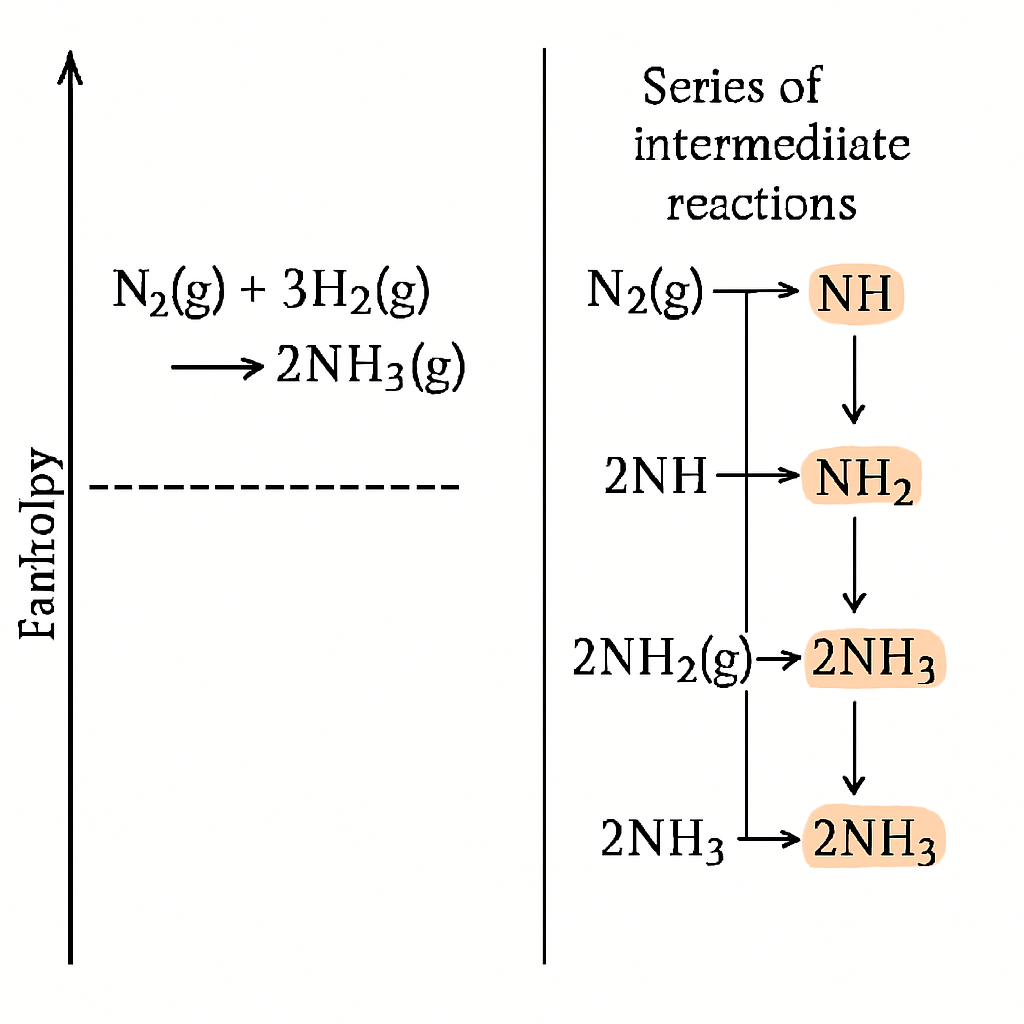
Consider a diagram illustrating a chemical process where N2(g) and 3H2(g) react to form 2NH3(g) in a single step and then in a series of intermediate reactions. According to Hess's Law, how does the total enthalpy change of the reaction compare between the single-step and multi-step processes?
The total enthalpy change is the same for both processes.
The total enthalpy change is greater in the series of intermediate reactions.
The total enthalpy change is greater in the single-step reaction.
The total enthalpy change cannot be determined from the diagram.
Correct Answer
Detailed Explanation
According to Hess's Law, the enthalpy change for a reaction is the same whether it occurs in one step or in a series of steps, as enthalpy is a state function.
Found an issue with this question?