Chemistry-(general)
NEET Chemistry (general) MCQ Question
Type: MCQ-diagram based-Medium-Class 11
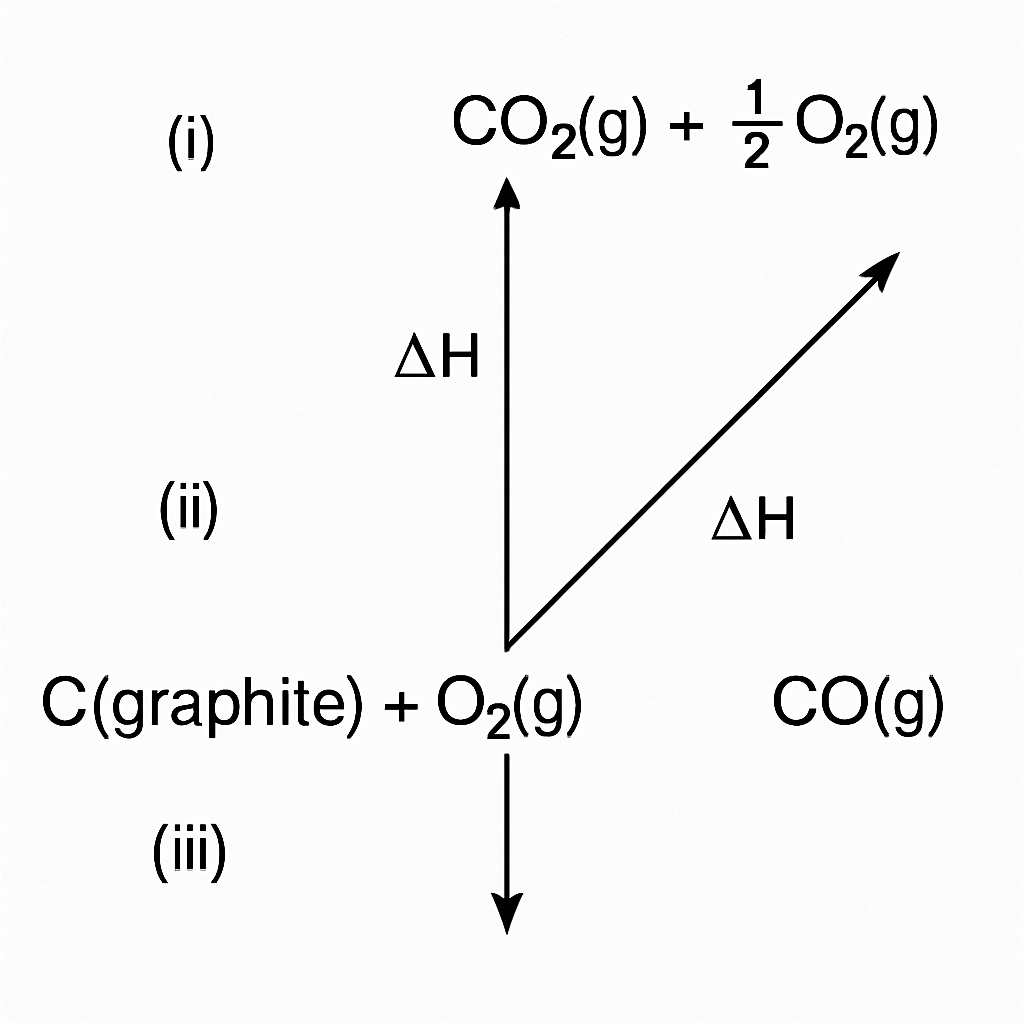
Consider a diagram showing the reaction pathway of the formation of CO(g) from C(graphite) and O2(g) using Hess's Law. The diagram includes three routes for the transformation: (i) C(graphite) + O2(g) → CO2(g), (ii) CO2(g) → CO(g) + 1/2 O2(g), and (iii) C(graphite) + 1/2 O2(g) → CO(g). Which equation represents the enthalpy change of the overall reaction according to Hess's Law?
A
∆rH = ∆rH1 + ∆rH3
B
∆rH = ∆rH1 - ∆rH2
C
∆rH = ∆rH2 + ∆rH3
D
∆rH = ∆rH1 + ∆rH2 + ∆rH3
Correct Answer
Option B
Detailed Explanation
Hess's Law states that the enthalpy change of a reaction is the sum of the enthalpies of its steps. Here, the overall reaction is C(graphite) + 1/2 O2(g) → CO(g), which corresponds to ∆rH = ∆rH1 - ∆rH2.
Found an issue with this question?