NEET 2023 Chemistry Reduction Reactions MCQ Question
Identify product (A) in the following reaction:
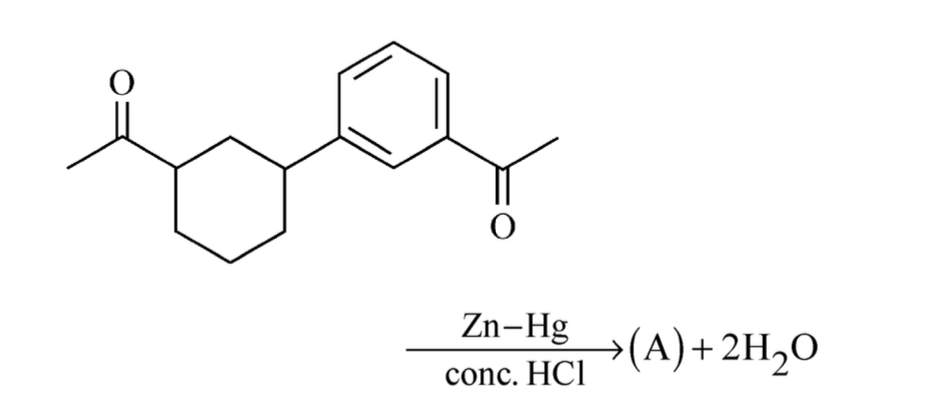
Correct Answer
Detailed Explanation
To analyze the reaction in question and identify product (A), we must first understand the nature of the reduction reaction being involved. Reduction reactions in organic chemistry typically involve the addition of hydrogen or the removal of oxygen from a compound, leading to an increase in the number of hydrogen atoms or a decrease in the oxidation state.
Explanation of the Correct Answer (D)
-
Understanding the Reaction Mechanism: Suppose we have a specific organic compound undergoing reduction. Common reducing agents include lithium aluminium hydride (LiAlH4), sodium borohydride (NaBH4), or catalytic hydrogenation (using H2 with a catalyst like Pd or Pt). Depending on the functional groups present in the substrate, these reducing agents can convert ketones to secondary alcohols, aldehydes to primary alcohols, or nitriles to primary amines, for example.
-
Identifying Product (A): If the correct answer is D, it means that the product formed after the reduction process matches the structure or formula given in Option 4. For example, if the substrate was a ketone and the reduction produced a secondary alcohol, Option 4 would correctly represent this secondary alcohol.
-
Verification with Reaction Conditions: Typically, you would analyze the functional groups present before and after the reaction. For instance, if a ketone (R2C=O) is reduced, the product would be a secondary alcohol (R2CHOH). The presence of a hydroxyl group (-OH) in the final product is a key indicator of successful reduction.
Why Other Options Are Incorrect
-
Option 1 (A): If this option represents an unreacted form of the starting material or a different compound altogether, it cannot be the product of the reduction reaction. For example, if this option is a carboxylic acid instead of an alcohol, it indicates no reduction occurred.
-
Option 2 (B): This option could potentially represent an over-reduced product or a completely different transformation (like oxidation). If it represents a compound that has a higher oxidation state than the original substrate, it would be incorrect.
-
Option 3 (C): If this option suggests a product that does not match the expected outcome of a reduction (for instance, a compound that retains the carbonyl group without conversion to an alcohol), then it does not reflect the chemistry of the reduction reaction.
Summary of Key Concepts
-
Reduction: A chemical reaction that involves the gain of electrons or hydrogen, or the loss of oxygen. It typically lowers the oxidation state of a molecule.
-
Common Reductions:
- Ketones to alcohols:
- Aldehydes to alcohols:
-
Functional Group Transformation: The identification of product (A) requires recognizing how the functional groups change during the reaction.
In conclusion, considering the structure of the organic substrate and the type of reduction performed, the correct identification of product (A) as Option D indicates a successful reduction process, while the incorrect options do not align with the expected outcome based on organic chemistry principles.
Found an issue with this question?
Related Questions
More from 2023
A football player is moving southward and suddenly turns eastward with the same speed to avoid an opponent. The force that acts on the player while tu...
In tissue culture experiments, leaf mesophyll cells are put in a culture medium to form callus. This phenomenon may be called as :
Match List I with List II.