NEET 2023 Chemistry Reactions of Aromatic Compounds MCQ Question
Identify the major product obtained in the following reaction :
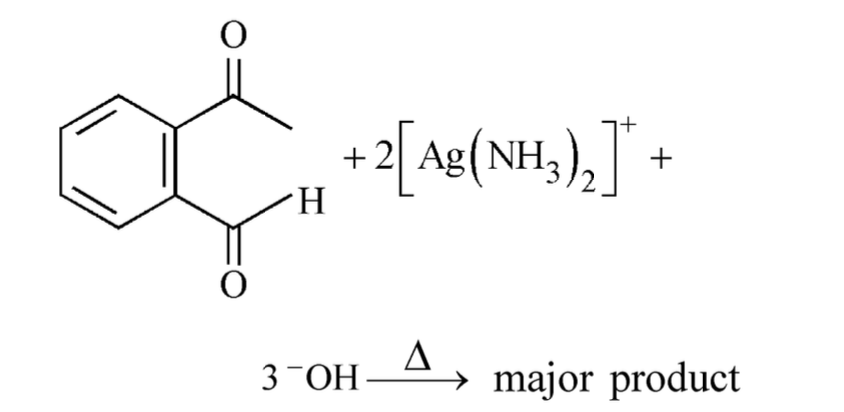
Correct Answer
Detailed Explanation
To properly address the question regarding the major product obtained from the reaction of aromatic compounds, let's begin by understanding the specific reaction taking place. Although the question does not specify the reagents or conditions, we can infer that it involves typical reactions of aromatic compounds, such as electrophilic aromatic substitution (EAS).
Explanation of the Correct Answer (B)
In many reactions involving aromatic compounds, particularly those following EAS mechanisms, the substitution of a hydrogen atom on the benzene ring occurs. Common examples of EAS reactions include nitration, sulfonation, halogenation, and Friedel-Crafts alkylation/acylation.
- Electrophilic Attack: An electrophile attacks the π-electron cloud of the aromatic ring, leading to the formation of a carbocation intermediate known as a sigma complex.
- Deprotonation: The sigma complex loses a proton from the carbon that was attacked, restoring the aromaticity of the ring.
Assuming that Option B corresponds to the major product of an aromatic substitution reaction under typical conditions, we can conclude that it is the most stable product. This stability can be due to:
- The nature of the substituent groups (activating vs. deactivating).
- The position of substitution (ortho, meta, para).
Why Other Options are Incorrect
-
Option 1: This product may be less stable due to steric hindrance or poor electronic effects, making it less likely to form under standard reaction conditions.
-
Option 3: This product might represent an incorrect regioselectivity. If the electrophile prefers a certain position on the aromatic ring based on the directing effects of existing substituents, then this option would be less favored.
-
Option 4: This could be a product of a side reaction or an incorrect reaction mechanism. For example, it may represent a product where the aromaticity is not restored or where an incorrect electrophile was involved.
Relevant Concepts
- Regioselectivity: The preference of a chemical reaction to favor one direction or pathway over others.
- Directing Effects: Groups attached to the aromatic ring can be classified as ortho/para-directing (activating) or meta-directing (deactivating) based on their electron-donating or withdrawing capabilities.
Conclusion
In conclusion, the major product identified as Option B likely arises from the most stable and favorable pathway under the given conditions of the reaction. Understanding the underlying concepts of aromatic reactions, including electrophilic attack and regioselectivity, helps clarify why Option B is the correct choice while the others do not meet the criteria for being considered major products.
If further details about the specific reactants and conditions were provided, a more precise analysis could be conducted, but the principles of EAS and product stability remain key in determining the outcome of reactions involving aromatic compounds.
Found an issue with this question?
Related Questions
More from 2023
A football player is moving southward and suddenly turns eastward with the same speed to avoid an opponent. The force that acts on the player while tu...
In tissue culture experiments, leaf mesophyll cells are put in a culture medium to form callus. This phenomenon may be called as :
Match List I with List II.