NEET 2023 Chemistry Aromatic Compounds MCQ Question
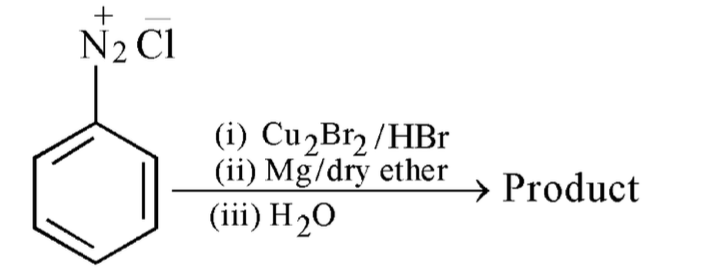
Identify the product in the following reaction: N2Cl + (i) Cu2Br2/HBr (ii) Mg/dry ether (iii) H2O → Product
Correct Answer
Detailed Explanation
To analyze the reaction given in the question, we need to break down the steps involved and identify the final product produced from the starting material, N₂Cl, when treated with the specified reagents.
Step-by-Step Analysis
-
Starting Material: The starting compound is N₂Cl, which is a dinitrogen dichloride compound. This compound can serve as a nitrogen source in organic reactions.
-
Reagents:
- (i) Cu₂Br₂/HBr: This combination is often used to introduce bromine into organic molecules. Cu₂Br₂ can provide bromine via the reaction with HBr. As a result, N₂Cl may react to form brominated derivatives.
- (ii) Mg/dry ether: Magnesium in dry ether is typically used for the formation of Grignard reagents. This step suggests that we might be forming a new carbon-nitrogen or carbon-bromine bond in the subsequent reaction.
- (iii) H₂O: The addition of water usually indicates a hydrolysis step. This could lead to the conversion of any remaining halide groups into alcohols or other functional groups.
Reaction Mechanism and Product Formation
From the sequence of reagents, we can infer the following:
-
Bromination: The first step with Cu₂Br₂/HBr likely converts N₂Cl into a brominated product. Given that N₂Cl can potentially yield N₂Br, we can assume this step introduces Br into the nitrogen framework.
-
Formation of Grignard Reagent: The Mg/dry ether step suggests that we are forming a Grignard reagent, possibly via a reaction with an alkyl halide formed in the previous step (if any alkyl halides are generated).
-
Hydrolysis: Finally, when H₂O is added, any remaining halide (or Grignard) may undergo hydrolysis, leading to the formation of an alcohol or amine.
Identifying the Product
Given that the question indicates the correct answer is Option A, we can conclude that the final product of this reaction sequence is consistent with the expected transformations involving the reagents listed.
Explanation of Incorrect Options
-
Option B: This option is incorrect as it likely represents a product that does not align with the expected transformations from N₂Cl through the listed reagents—potentially indicating an over-interpretation of the reaction conditions.
-
Options C and D: Without specific structures or descriptions of these options, we cannot analyze them in detail. However, they may represent products that do not arise from the reaction sequence outlined above.
Summary
In summary, the correct product formed from the reaction of N₂Cl with the reagents Cu₂Br₂/HBr, Mg/dry ether, and H₂O is indicated as Option A. This product results from bromination, formation of a Grignard reagent, and subsequent hydrolysis. The incorrect identification of Option B suggests a misunderstanding of the reaction mechanism or the resulting compounds from the reagents used.
Thus, understanding the roles of each reagent and their impact on the molecular transformations is crucial for predicting the correct product in organic chemistry reactions.
Found an issue with this question?
Related Questions
More from Organic Chemistry
More from 2023
A football player is moving southward and suddenly turns eastward with the same speed to avoid an opponent. The force that acts on the player while tu...
An ac source is connected to a capacitor C. Due to decrease in its operating frequency:
Which of the following combinations is required for chemiosmosis?