NEET Chemistry pH & Buffer Solutions MCQ Question
Consider a diagram depicting the hydrolysis of a salt formed from a weak acid and weak base, such as ammonium acetate. The diagram shows the equilibrium reactions involved during hydrolysis. Which of the following correctly describes the pH of the solution at equilibrium?
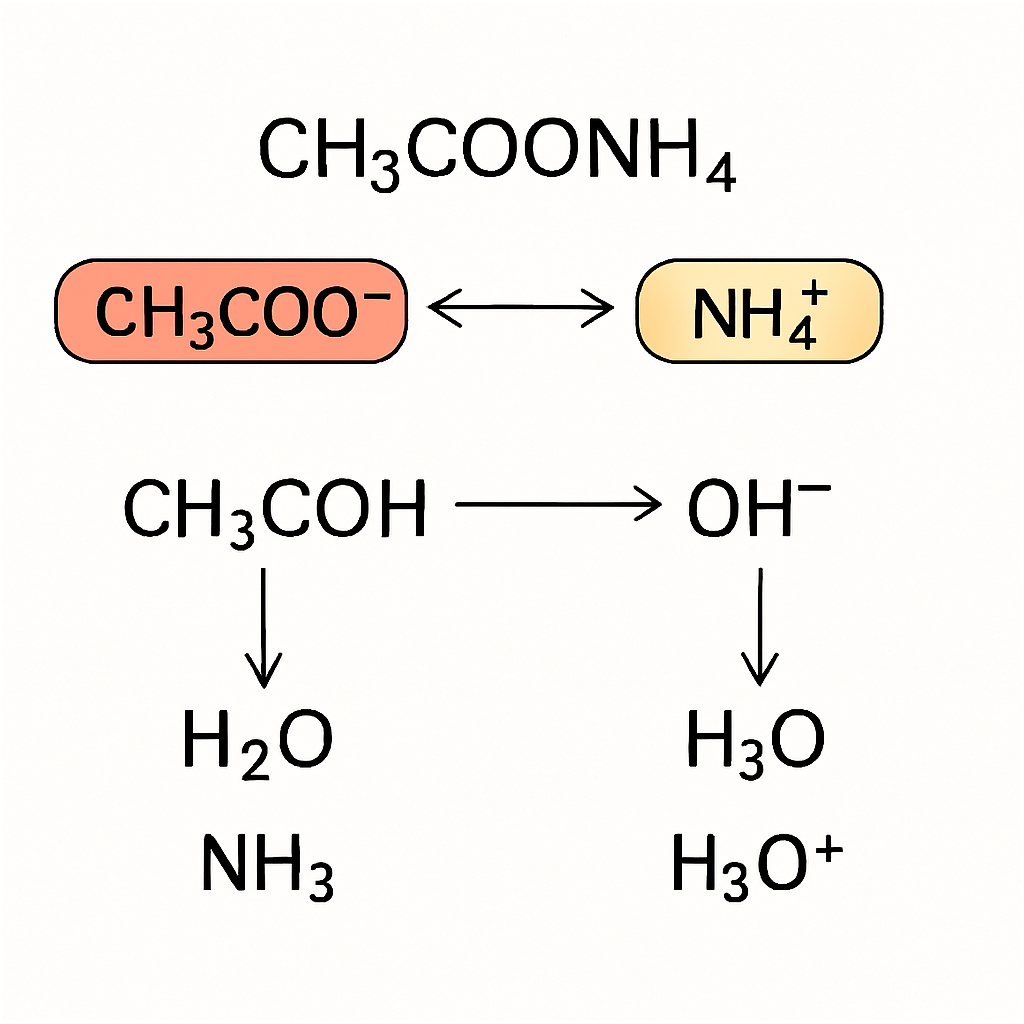
The pH is determined by the equation pH = 7 + ½ (pKa - pKb).
The pH is always greater than 7 because both acid and base are weak.
The pH solely depends on the concentration of ammonium acetate.
The pH is 7 because the solution is neutral.
Correct Answer
Detailed Explanation
The pH of a solution formed from a weak acid and weak base, such as ammonium acetate, is calculated using the equation pH = 7 + ½ (pKa - pKb).
Found an issue with this question?
Related Questions
More from
In the diagram shown above, which graph best represents the change in concentration of H2 as the reaction H2(g) + I2(g) → 2HI(g) proceeds to equilibri...
Assertion (A): For a dibasic acid H2X, the equilibrium constant for the first ionization step (Ka1) is generally greater than that for the second ioni...
Assertion (A): The solubility of a sparingly soluble salt is affected by the presence of a common ion. | Reason (R): The solubility product constant (...