

NEET Botany Tissue Systems Match the Following Question
Match Column-I with Column-II.
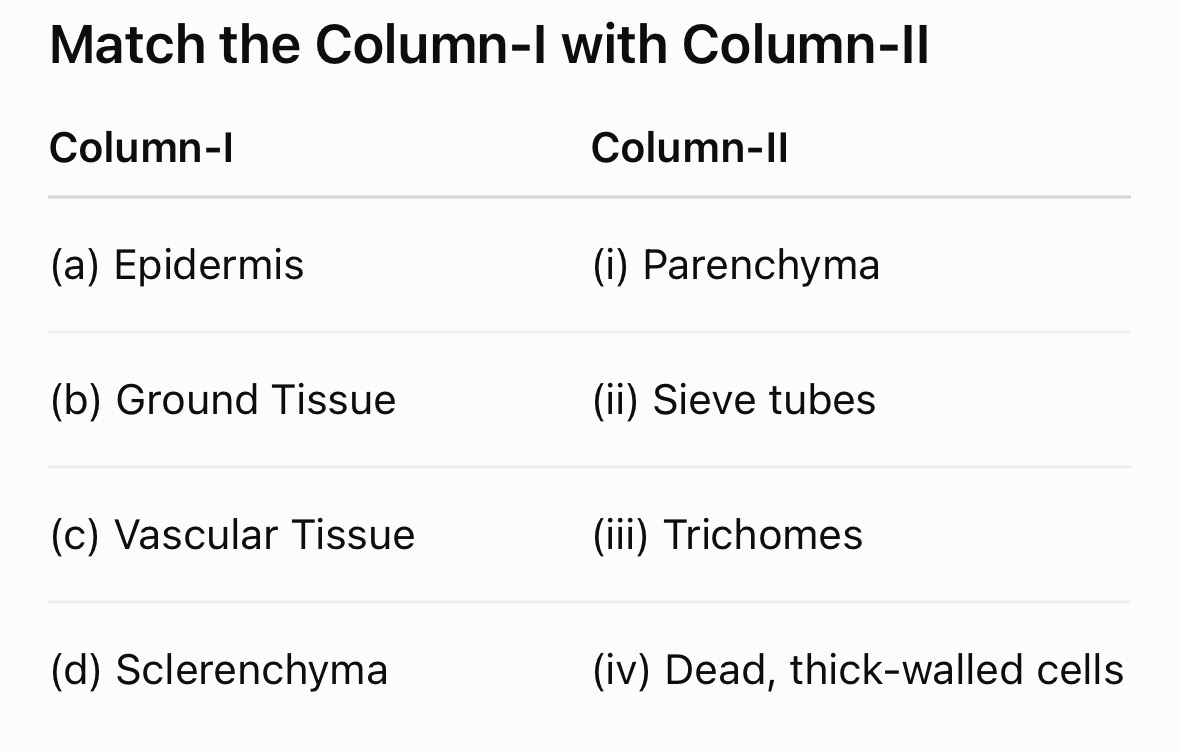
| Column-I | Column-II |
|---|---|
| (a) Epidermis | (i) Parenchyma |
| (b) Ground Tissue | (ii) Sieve tubes |
| (c) Vascular Tissue | (iii) Trichomes |
| (d) Companion Cells | (iv) Sclerenchyma |
a-iii, b-i, c-ii, d-iv
a-ii, b-iv, c-i, d-iii
a-iv, b-iii, c-i, d-ii
a-i, b-ii, c-iii, d-iv
Correct Answer
Detailed Explanation
🧠 Explanation -
Correct Matching
(a)–(iii), (b)–(i), (c)–(ii), (d)–(iv)
- Epidermis → Trichomes: Trichomes are epidermal outgrowths.
- Ground tissue → Parenchyma: Parenchyma forms a major part of ground tissue.
- Vascular tissue → Sieve tubes: Sieve tubes are conducting elements of phloem.
- Sclerenchyma → Dead, thick-walled cells: Sclerenchymatous cells provide mechanical strength and are generally dead at maturity.
⚡ Quick Revision
Epidermis → Trichomes Ground tissue → Parenchyma Phloem → Sieve tubes + Companion cells Sclerenchyma → Dead + lignified + thick-walled
👉 NEET Tip: Companion cells are living cells of phloem, so never match them with sclerenchyma.
Found an issue with this question?
Related Questions
More from Tissue Systems
More from
Match Column-I with Column-II. Column-I Column-II (a) Dicot Stem (i) Scattered vascular bundles (b) Monocot Stem (ii) Conjoint and open vascu...
In a dicot root undergoing secondary growth, if the cambial ring produces 150 cells towards the xylem and 100 cells towards the phloem, what is the ra...
Assertion (A): The cambium is generally more active on the inner side than on the outer. | Reason (R): This results in the formation of more secondary...