

AIPMT PRELIMS 2004 Physics Energy Conservation MCQ Question
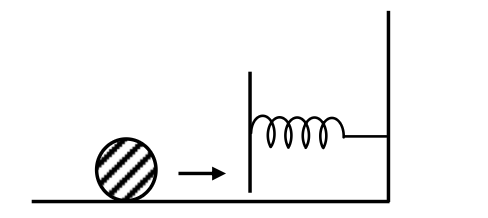
A mass of 0.5 kg moving with a speed of 1.5 m/s on a horizontal smooth surface, collides with a nearly weightless spring of force constant k = 50 N/m. The maximum compression of the spring would be :-
0.12 m
1.5 m
0.5 m
0.15 m
Correct Answer
Detailed Explanation
To solve this problem, we will apply the principle of conservation of energy. When the mass collides with the spring and compresses it, the kinetic energy of the mass is converted into the potential energy stored in the spring at maximum compression.
Step-by-Step Explanation
-
Initial Kinetic Energy of the Mass: The initial kinetic energy () of the mass can be calculated using the formula: where:
- (mass of the object)
- (initial speed of the object)
Substituting the values:
-
Potential Energy in the Spring: The potential energy () stored in the spring at maximum compression can be expressed as: where:
- (spring constant)
- is the maximum compression of the spring.
-
Applying Conservation of Energy: According to the conservation of energy, the initial kinetic energy of the mass will be equal to the potential energy stored in the spring at maximum compression:
Rearranging the equation to solve for :
Conclusion
The maximum compression of the spring is .
Correct Answer: D) 0.15 m
Clarification of Other Options
- Option A (0.12 m): This value is less than the calculated maximum compression, indicating that not all the kinetic energy is converted to potential energy.
- Option B (1.5 m): This value is unreasonably large compared to the initial kinetic energy available; it suggests an implausible amount of compression.
- Option C (0.5 m): Similar to option B, this value exceeds the calculated maximum compression and does not conserve energy, as it would require much more energy than what the mass possesses.
Thus, the only viable answer based on the calculations and conservation of energy is D) 0.15 m.
Found an issue with this question?