

AIPMT PRELIMS 2005 Physics Moment of Inertia MCQ Question
The moment of inertia of a uniform circular disc of radius R and mass M about an axis passing from the edge of the disc and normal to the disc is:
(5/2)MR²
MR²
(7/2)MR²
3/2MR²
Correct Answer
Detailed Explanation
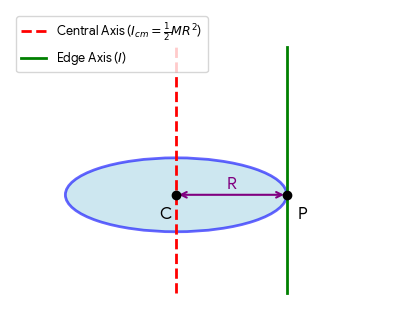
The correct choice is option (3) . Here is the step-by-step derivation using the parallel axis theorem:
1. Central Axis Moment of Inertia
The moment of inertia () of a uniform circular disc about a central axis passing through its center of mass and perpendicular (normal) to its plane is:
2. Parallel Axis Theorem
According to the parallel axis theorem, the moment of inertia () about any parallel axis at a distance from the center of mass axis is given by: Since the new axis passes through the edge of the disc, the distance between the two parallel axes is equal to the radius of the disc:
3. Total Moment of Inertia
Substituting the values into the formula:
Found an issue with this question?
Related Questions
More from 2005
AIDS is caused by HIV that principally infects:
Assertion : The logic gate NOT can be built using diode. Reason : The output voltage and the input voltage of the diode have 180° phase difference.
In a semiconducting material the mobilities of electrons and holes are μₑ and μₕ, respectively. Which of the following is true?