

AIPMT PRELIMS 2004 Physics Moment of Inertia MCQ Question
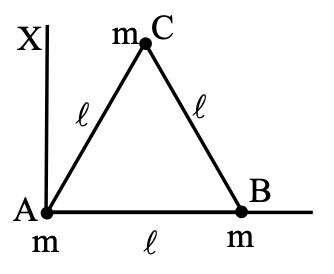
Three particles, each of mass m gram, are situated at the vertices of an equilateral triangle ABC of side ℓ cm. (as shown in the figure). The moment of inertia of the system about a line AX perpendicular to AB and in the plane of ABC, in gram cm² units will be :-
2 mℓ²
5/4 mℓ²
3/2 mℓ²
3/4 mℓ²
Correct Answer
Detailed Explanation
To solve the problem of finding the moment of inertia of three particles situated at the vertices of an equilateral triangle about a line AX that is perpendicular to the base AB, let's break down the solution step by step.
Step 1: Understanding the Configuration
We have three particles, each of mass grams, located at the vertices of an equilateral triangle ABC with side length cm. The vertices can be represented in a coordinate system as follows:
- Vertex A:
- Vertex B:
- Vertex C:
Step 2: Moment of Inertia Definition
The moment of inertia of a system of point masses about an axis is given by the formula:
where is the mass of each particle and is the perpendicular distance of each particle from the axis of rotation.
Step 3: Calculate Distances from AX
The line AX is perpendicular to AB and can be considered as a vertical line passing through point A. The distances of each particle from this line (AX) are as follows:
-
For particle A at :
- Distance from AX = 0 cm
-
For particle B at :
- Distance from AX = cm
-
For particle C at :
- The distance from AX (the x-coordinate distance) = cm
Step 4: Calculate Moment of Inertia for Each Particle
Now we can calculate the moment of inertia for each particle about the axis AX:
-
For particle A:
-
For particle B:
-
For particle C:
Step 5: Total Moment of Inertia
Now, summing up the contributions from all three particles, we have:
Combining the terms gives:
Therefore, the moment of inertia is:
Conclusion
The correct answer to the moment of inertia of the system about the line AX is indeed:
Correct Answer: B)
Why Other Options Are Incorrect
- Option A (2 mℓ²): This overestimates the contributions by not accounting for the distances correctly.
- Option C (3/2 mℓ²): This also does not correctly represent the summed distances from the axis.
- Option D (3/4 mℓ²): This underestimates the contributions from the distances of particles B and C.
In summary, the calculations show that the total moment of inertia correctly corresponds to option B, and the reasoning for the spatial arrangement of the particles is crucial for understanding the calculation of distances.
Found an issue with this question?
Related Questions
More from 2004
Assertion : A transistor amplifier in common emitter configuration has a low input impedence. Reason : The base to emitter region is forward biased.
Assertion : Tapeworm, roundworm and pinworm are endoparasites of human intestine. Reason : Improperly cooked food is the source of all intestinal in...