AIIMS 2006 Zoology Enzyme Kinetics MCQ Question
The figure given below shows three velocity-substrate concentration curves for an enzyme reaction. What do the curves a, b, and c depict respectively?
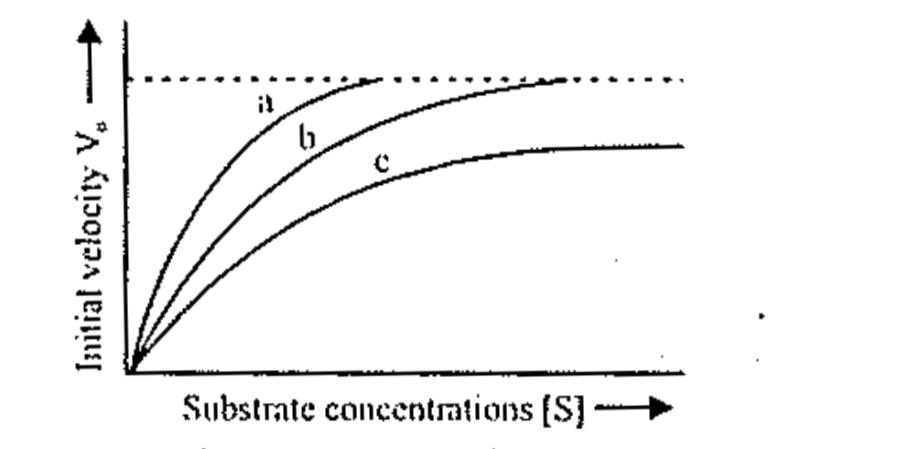
a-normal enzyme reaction, b-competitive inhibition, c-non-competitive inhibition
a-enzyme with an allosteric modulator added, b-normal enzyme activity, c-competitive inhibition
a-enzyme with an allosteric stimulator, b-competitive inhibition added, c-normal enzyme reaction
a-normal enzyme reaction, b-non-competitive inhibitor added, c-allosteric inhibitor added
Correct Answer
Detailed Explanation
To understand the question regarding the three velocity-substrate concentration curves for an enzyme reaction, let's first recap some fundamental concepts of enzyme kinetics.
Key Concepts
-
Michaelis-Menten Kinetics: The basic model describes the rate of enzymatic reactions by relating reaction rate (velocity) to substrate concentration. The Michaelis-Menten equation is given by:
where:
- = reaction velocity
- = maximum reaction velocity
- = substrate concentration
- = Michaelis constant (substrate concentration at which the reaction velocity is half of )
-
Inhibition Types:
- Competitive Inhibition: The inhibitor competes with the substrate for the active site of the enzyme. This increases the but does not affect .
- Non-Competitive Inhibition: The inhibitor binds to an allosteric site, which reduces without affecting .
- Allosteric Modulation: This can either enhance or inhibit enzyme activity and results in a sigmoidal (S-shaped) curve instead of a hyperbolic one.
Explanation of the Correct Answer (Option A)
In the provided question, curves a, b, and c depict different enzyme activity scenarios:
-
Curve a: This curve represents a normal enzyme reaction, where the reaction velocity increases with increasing substrate concentration, following the Michaelis-Menten kinetics as described above. Here, is reached as the substrate concentration increases sufficiently.
-
Curve b: This curve depicts competitive inhibition. In competitive inhibition, the presence of an inhibitor increases the apparent (the value of substrate concentration at which the velocity is half of ), leading to a lower reaction velocity at lower substrate concentrations compared to the normal reaction (curve a). However, remains unchanged if enough substrate is present.
-
Curve c: This curve represents non-competitive inhibition. In this case, the reaction velocity does not reach the same as in a normal reaction (curve a), indicating that the presence of a non-competitive inhibitor reduces the maximum velocity without affecting .
Thus, the interpretation aligns perfectly with Option A:
- Curve a = normal enzyme reaction
- Curve b = competitive inhibition
- Curve c = non-competitive inhibition
Clarification of Incorrect Options
-
Option B: This option suggests that curve b represents normal enzyme activity. However, if it were normal activity, it would not show the characteristic change in associated with competitive inhibition. Thus, this option is incorrect.
-
Option C: This option indicates that curve a represents an enzyme with an allosteric stimulator. While allosteric enzymes can show enhanced activity, they typically exhibit sigmoidal kinetics rather than hyperbolic. Therefore, this option does not fit the description of the curves.
-
Option D: This option claims that curve b represents a non-competitive inhibitor. This is incorrect because in a non-competitive scenario, the reaction velocity would not reach the same maximum as the normal enzyme reaction, unlike what is depicted in curve b.
Conclusion
The correct interpretation of the curves leads us to conclude that Option A is indeed correct. The various types of inhibition can be identified through the distinct shapes of the velocity-substrate concentration curves, allowing us to analyze enzyme kinetics effectively. The curves reflect the intricate dynamics of enzyme interactions with substrates and inhibitors, foundational concepts in biochemistry and zoology.
Found an issue with this question?