

AIIMS 2003 Physics Mirror Formula MCQ Question
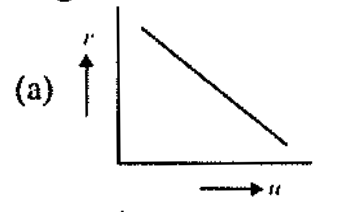
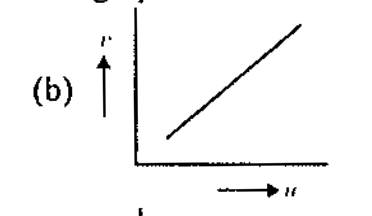
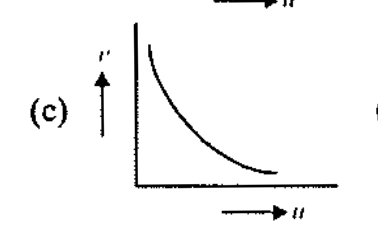
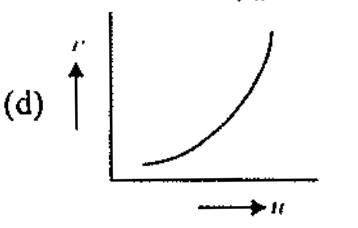
In an experiment to find the focal length of a concave mirror a graph is drawn between the magnitudes of u and v. The graph looks like
Correct Answer
Detailed Explanation
To analyze the relationship between the object distance and the image distance for a concave mirror, we use the mirror formula:
where is the focal length of the mirror, is the object distance (measured from the mirror along the principal axis), and is the image distance (also measured from the mirror along the principal axis). For a concave mirror, the focal length is considered negative according to the sign convention used in optics.
Understanding the Graph of Magnitudes of and
When we plot a graph of the magnitudes of against , we need to consider the signs of these distances. The mirror formula can be rearranged to express in terms of :
In this equation, as the object distance varies, we can observe the following:
- When approaches from the right (greater than ), becomes very large (positively or negatively depending on the sign convention).
- When is less than , becomes negative, indicating that the image is virtual and located on the same side as the object.
Correct Answer and Explanation
Correct Answer: C - The graph will be a hyperbola. This is because the equation can be manipulated to show that as approaches , tends to infinity, and as increases beyond , becomes positive and approaches a finite limit. This behavior is characteristic of a hyperbolic curve.
Why Other Options Are Incorrect
-
Option A: Linear Graph - A linear relationship would imply that changes directly in proportion to . This does not hold true since the relationship is hyperbolic, not linear.
-
Option B: Parabolic Graph - A parabolic relationship suggests a quadratic dependency, which is not the case here. The relationship derived from the mirror formula is not quadratic in nature but follows the inverse relationship characteristic of hyperbolas.
-
Option D: Circular Graph - A circular or elliptical relationship implies a constant radius or a set of values that maintain a fixed distance. This is not applicable to the behavior of a concave mirror, where the relationship between and does not form a closed loop.
Summary
In conclusion, the relationship between the magnitudes of and for a concave mirror is hyperbolic due to the inverse relationship defined by the mirror formula. Thus, plotting the magnitudes of against results in a hyperbolic curve, confirming that the correct answer is option C.
Found an issue with this question?