

AIIMS 2003 Physics Black Body Radiation MCQ Question
Shown below are the black body radiation curves at temperatures T₁ and T₂ (T₂ > T₁). Which of the following plots is correct?
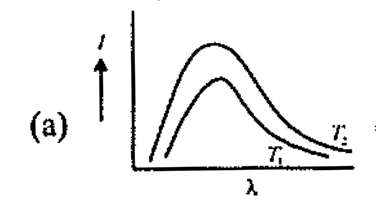
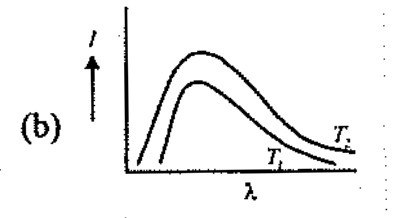
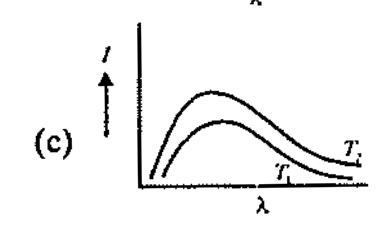
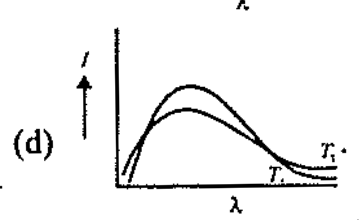
Correct Answer
Detailed Explanation
To understand the question regarding black body radiation curves at different temperatures and (where ), we need to delve into the physics of black body radiation, as described by Planck's law.
Explanation of Black Body Radiation
A black body is an idealized physical body that absorbs all incident electromagnetic radiation, regardless of frequency or angle of incidence. The spectral radiance of a black body at temperature is given by Planck's law:
Where:
- is the spectral radiance (intensity) at wavelength ,
- is Planck's constant,
- is the speed of light,
- is Boltzmann's constant,
- is the absolute temperature of the black body.
Key Characteristics of Black Body Radiation Curves
- Temperature Dependence: As the temperature increases, the peak of the black body radiation curve shifts to shorter wavelengths. This phenomenon is described by Wien's Displacement Law, which states:
where is Wien's displacement constant (approximately ). Therefore, for , .
- Intensity of Radiation: The total intensity of radiation emitted by a black body also increases with temperature. According to the Stefan-Boltzmann Law, the total power emitted per unit area is given by:
where is the Stefan-Boltzmann constant. This means that as the temperature increases, the area under the curve (total intensity) increases significantly.
Analysis of the Correct Answer (C)
In the correct plot (C), we would observe that:
- The curve corresponding to temperature is positioned to the left of the curve corresponding to temperature , indicating that the peak wavelength for is shorter.
- The curve for is higher than that for at all wavelengths, illustrating that the intensity of radiation at higher temperatures is greater.
Clarification of Incorrect Options
If other options (A, B, D, etc.) depict:
-
Incorrect Peak Wavelengths: If they show the peak wavelength of being longer than , they violate Wien's law.
-
Incorrect Intensity Levels: If they show the curve for below , they contradict the Stefan-Boltzmann Law, which states that higher temperatures correspond to higher radiation intensity across all wavelengths.
Summary
The correct black body radiation curve for temperatures and (where ) must show:
- A shift of the peak to shorter wavelengths for .
- A greater intensity for across the spectrum.
Thus, option C accurately represents these characteristics, while other options fail to do so based on the fundamental principles of black body radiation.
Found an issue with this question?