

AIIMS 2007 Physics Moment of Inertia MCQ Question
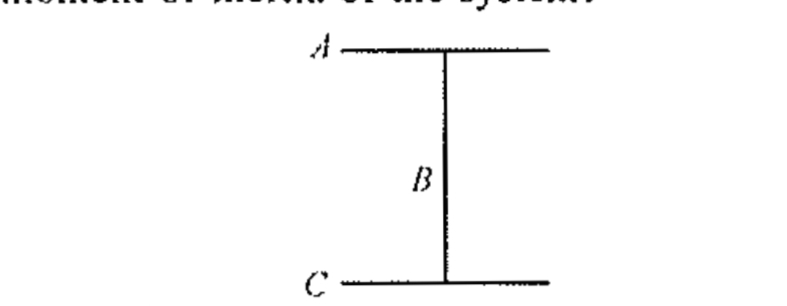
In the diagram shown below all three rods are of equal length L and equal mass M. The system is rotated such that rod B is the axis. What is the moment of inertia of the system?
ML²/6
3ML²/2
ML²/3
3ML²/2
Correct Answer
Detailed Explanation
The axis is rod B itself. A thin rod has no mass away from its own length axis, so rod B contributes nothing: .
Rods A and C are perpendicular to the axis, and the axis passes through each rod’s midpoint. For a rod of length about a perpendicular axis through its centre,
so
The tempting mistake is to add for rods A and C — but their centres lie on the axis, so there is no parallel-axis term — or to give rod B , which is its moment of inertia about a perpendicular axis, not about its own length.
Found an issue with this question?
Related Questions
More from 2007
CH₃OC₂H₅ and (CH₃)₃C – OCH₃ are treated with concentrated acidic iodide. The fragments after reactions obtained are
Which of the following is an eye disease?
Which one of the following is a fat-soluble vitamin and its related deficiency disease?