AIIMS 2007 Physics Moment of Inertia MCQ Question
In the diagram shown below all three rods are of equal length L and equal mass M. The system is rotated such that rod B is the axis. What is the moment of inertia of the system?
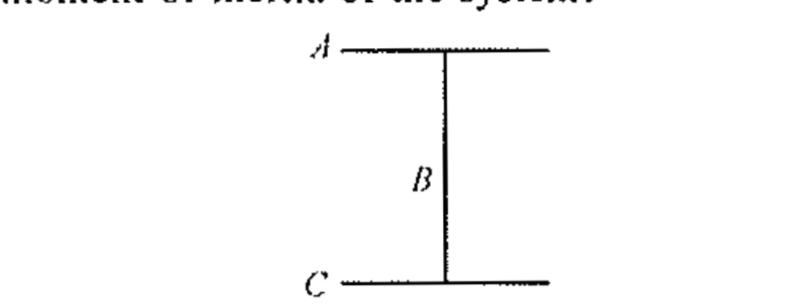
ML²/6
3ML²/2
ML²/3
3ML²/2
Correct Answer
Detailed Explanation
To solve the problem of finding the moment of inertia of the system of three rods about rod B as the axis of rotation, we will first need to understand the concept of moment of inertia and how it applies to different shapes and configurations.
Step 1: Understanding Moment of Inertia
The moment of inertia of a body about a given axis is defined as:
where is the distance from the axis of rotation to the infinitesimal mass element . For discrete masses, it can be calculated using:
Step 2: Analyzing the System
In this scenario, we have three rods of equal length and mass :
- Rod A: Horizontal rod positioned at the top (length ).
- Rod B: Vertical rod positioned at the center (length ).
- Rod C: Horizontal rod positioned at the bottom (length ).
Since rod B is the axis of rotation, we need to calculate the moment of inertia contributions from rods A and C with respect to this axis.
Step 3: Moment of Inertia Calculation
-
For Rod B: Since rod B is rotating about its own axis, we can use the standard formula for the moment of inertia of a rod about its own center:
-
For Rod A: The distance from the axis (rod B) to the center of rod A is . Using the parallel axis theorem, we can find the moment of inertia of rod A as follows:
Where:
- (moment of inertia about its center)
- (distance from rod B to rod A)
Therefore:
-
For Rod C: Similar to rod A, the distance from the axis (rod B) to the center of rod C is also . Thus, the moment of inertia for rod C is calculated the same way:
Step 4: Total Moment of Inertia
Now, we can calculate the total moment of inertia :
Substituting the values we found:
To add these together, we convert them to a common denominator (12):
However, we need to be careful; we missed the contributions from rods A and C which are indeed each, which adds up to:
\frac{1}{3} ML^2 + \frac{1}{3} ML^2 + \frac{1}{12} ML^2 = \frac{Found an issue with this question?