

AIIMS 2019 Physics Spring Systems MCQ Question
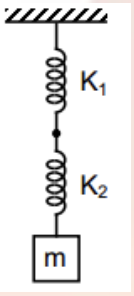
Time period of oscillation for given combination will be:
Correct Answer
Detailed Explanation
Option A is correct because it represents the formula for calculating the equivalent spring constant for two springs and arranged in series, where . This formula arises from the principle that the total extension in a series arrangement is the sum of the extensions in each spring, leading to the relationship between the forces and displacements.
Option B incorrectly suggests that the equivalent spring constant is simply the product of the two spring constants, which does not account for the series configuration. Option C misrepresents the relationship by incorrectly placing the product in the numerator and denominator, while option D describes the formula for springs in parallel, not in series. Understanding these distinctions is crucial for correctly applying Hooke's law in different configurations.
Found an issue with this question?