

AIIMS 2004 Physics Spring-Mass System MCQ Question
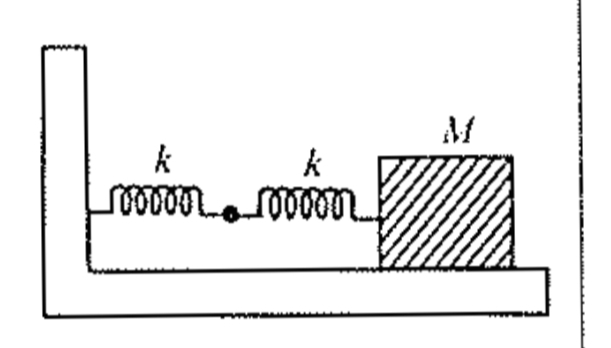
Two springs are connected to a block of mass M placed on a frictionless surface as shown below. If both the springs have a spring constant k, the frequency of oscillation of the block is
1 / (2π) √(k / M)
1 / (2π) √(k / 2M)
1 / (2π) √(2k / M)
1 / (2π) √(M / k)
Correct Answer
Detailed Explanation
To determine the frequency of oscillation of a block of mass connected to two springs with a spring constant each, we begin by analyzing the system's setup and applying the principles of oscillatory motion.
System Description
When the block is displaced from its equilibrium position, both springs will exert restoring forces on the block. As both springs are connected to the block in parallel (assuming they are oriented to pull the block back towards the center), the effective spring constant of the system can be calculated.
Effective Spring Constant
For two springs in parallel, the effective spring constant is the sum of the individual spring constants:
Frequency of Oscillation
The frequency of a mass-spring system is generally given by the formula:
Substituting the effective spring constant into this equation, we have:
Correct Answer
Based on the derivation above, we can see that the frequency of oscillation of the block is:
Thus, the correct answer is C) .
Explanation of Other Options
Now, let’s analyze why the other options are incorrect:
-
Option A:
This formula represents the frequency of a single spring connected to the mass. Since we have two springs, this does not account for the effect of the second spring, thus leading to the wrong frequency. -
Option B:
This option incorrectly suggests that the effective spring constant is halved (which is incorrect). The effective spring constant is when both springs are in parallel. -
Option D:
This option incorrectly represents a situation where the spring constant is in the denominator with mass in the numerator. This is not the correct form for calculating frequency as it does not represent the dynamics of the system correctly.
Conclusion
In summary, when two springs are used in parallel with a block of mass , the effective spring constant doubles, leading to a frequency of oscillation given by:
Thus, the correct answer is C).
Found an issue with this question?