

AIIMS 2003 Physics Spring Mass System MCQ Question
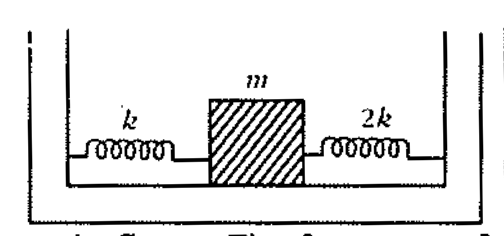
Two springs of force constants k and 2k are connected to a mass as shown in figure. The frequency of oscillation of the mass is
1/2π √(k/m)
1/2π √(2k/m)
1/2π √(3k/m)
1/2π √(k/m)
Correct Answer
Detailed Explanation
To determine the frequency of oscillation of a mass connected to two springs with force constants and , we first need to find the equivalent spring constant when the springs are arranged in parallel.
Step 1: Understanding the Configuration
Assuming the two springs are connected in parallel to the mass, the equivalent spring constant can be calculated as:
where (the spring constant of the first spring) and (the spring constant of the second spring). Therefore, we have:
Step 2: Frequency of Oscillation
The frequency of oscillation of a mass-spring system is given by the formula:
where is the equivalent spring constant and is the mass attached to the springs. Substituting the equivalent spring constant we found:
Conclusion
Thus, the frequency of oscillation of the mass is:
This matches with option C, confirming that the correct answer is C) .
Explanation of Incorrect Options
Now, let's clarify why the other options are incorrect:
-
Option A:
This option would be valid if there were only one spring with a spring constant . However, since we have two springs with constants and , this does not account for the combined effect of both springs.
-
Option B:
This would be true if the equivalent spring constant was , which again neglects the contribution of the spring . Thus, it only considers one spring.
-
Option D:
Similar to option A, this option only considers the spring with spring constant and ignores the second spring, leading to an incorrect calculation.
Summary
To summarize, the calculated equivalent spring constant for the two springs in parallel is . Therefore, the frequency of oscillation of the mass is given by:
This confirms that the correct answer is option C) .
Found an issue with this question?