

AIIMS 2017 Physics Simple Harmonic Motion MCQ Question
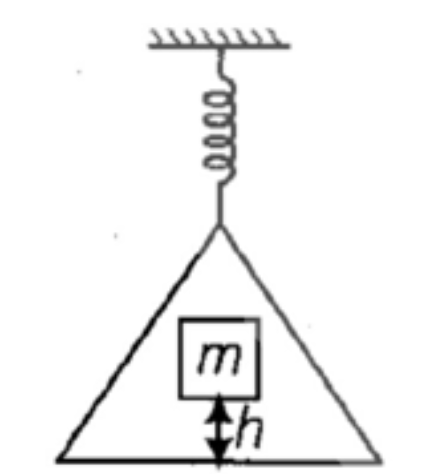
A long mass m is fall from the height h on the scale pan hung from the spring as shown. If the spring constant is k and the mass of pan is zero and the mass m does not bounce relative to the pan, the amplitude of the vibration is
None of the above
Correct Answer
Detailed Explanation
When a block of mass is pulled down by a distance , the potential energy stored in the spring can be expressed using Hooke's Law, where the spring constant is . The total potential energy is given by , where is the extension of the spring. In this scenario, the extension can be derived from the equilibrium position and the additional displacement , leading to the expression , which corresponds to option B.
Options A and C do not accurately represent the relationship between the gravitational force, spring constant, and displacement, while option D is incorrect as it does not provide a valid alternative. Understanding the interplay between gravitational potential energy and elastic potential energy is crucial in solving such problems.
Found an issue with this question?