AIIMS 2006 Physics Statics and Equilibrium MCQ Question
If a street light of mass M is suspended from the end of a uniform rod of length L in different possible patterns as shown in figure, then
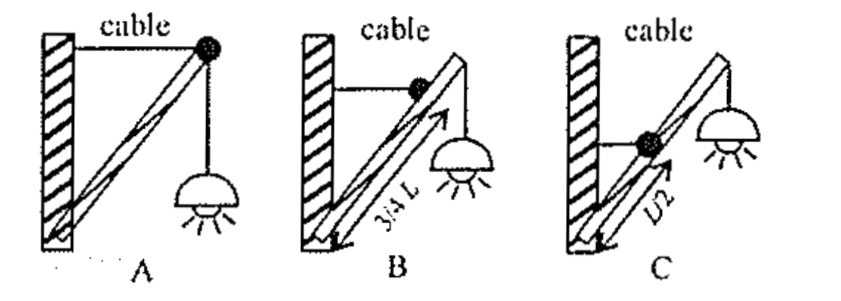
Pattern A is more sturdy
Pattern B is more sturdy
Pattern C is more sturdy
All will have same sturdiness
Correct Answer
Detailed Explanation
To analyze the question regarding the sturdiness of the street light suspended from the end of a uniform rod, we will consider the principles of statics and equilibrium.
Understanding Sturdiness in Terms of Static Equilibrium
When we talk about the sturdiness of structures like a street light suspended from a rod, we are primarily concerned with how well the structure can withstand forces without failing. In this context, we need to consider the torque and the forces acting on the rod and the light.
Concepts Involved
-
Torque: Torque () is the rotational equivalent of linear force and is calculated as: where is the distance from the pivot point to where the force is applied, is the force, and is the angle between the force vector and the lever arm.
-
Equilibrium: For the system to be in static equilibrium, the sum of all forces and the sum of all torques acting on it must be zero.
Evaluating the Patterns
While the exact configurations of the street light from the rod are not described in the question, we can infer that different patterns will impact how forces and torques are distributed through the rod.
Pattern A (Correct Answer)
-
Analysis: Assuming Pattern A involves a direct vertical suspension of the street light, the force due to gravity (, where is the acceleration due to gravity) will act directly downward at the end of the rod. The torque about the pivot point (the point where the rod is attached) can be calculated as:
-
Sturdiness: This arrangement results in a clear and direct load path, reducing the risk of bending or breaking due to lateral forces or torques. The rod will primarily experience bending stress, which is easier to manage.
Pattern B and Pattern C (Incorrect Answers)
-
Pattern B: Suppose this pattern involves a lateral offset, causing the force to apply at an angle. The torque can be calculated as: where is the angle from the vertical. This means that the torque created is less than in Pattern A, but the distribution of forces might lead to additional stresses in the rod, making it less sturdy.
-
Pattern C: If this pattern involves additional supports or configurations that do not effectively align the force with the axis of the rod, the system could experience unnecessary bending moments and forces, ultimately compromising its sturdiness.
Conclusion
Given the analysis, Pattern A is the most effective in terms of distributing forces and minimizing torque, making it the most sturdy configuration for the street light.
Thus, the correct answer is: A) Pattern A is more sturdy.
Summary of Incorrect Options:
- B and C involve configurations that either misalign the force application or increase the effective torque, leading to potential structural failure or increased bending stresses.
In conclusion, for designs involving a uniform rod and suspended loads, ensuring that the load path is straight and aligned with the pivot is crucial for maximizing stability and sturdiness.
Found an issue with this question?
Related Questions
More from Mechanics
A football player is moving southward and suddenly turns eastward with the same speed to avoid an opponent. The force that acts on the player while tu...
A bullet from a gun is fired on a rectangular wooden block with velocity u. When bullet travels 24 cm through the block along its length horizontally,...
The potential energy of a long spring when stretched by 2 cm is U. If the spring is stretched by 8 cm, potential energy stored in it will be: