AIIMS 2005 Physics Rotational Motion MCQ Question
A given shaped glass tube having uniform cross section is filled with water and is mounted on a rotatable shaft as shown in figure. If the tube is rotated with a constant angular velocity ω when
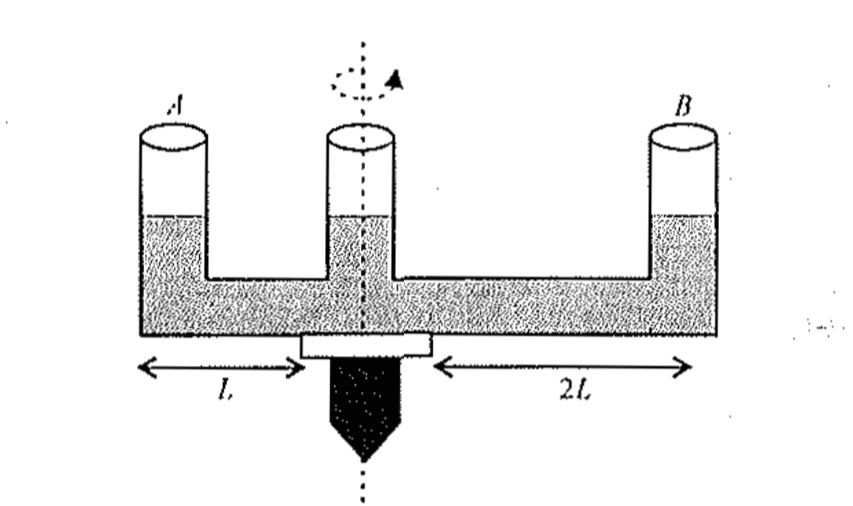
water levels in both sections A and B go up
water level in section A goes up and that in B comes down
water level in section A comes down and that in B it goes up
water levels remain same in both sections.
Correct Answer
Detailed Explanation
To solve this question, we need to understand the effects of rotational motion on the fluid (water) contained within a rotating glass tube.
Overview
When the tube is rotated with a constant angular velocity , it creates a centrifugal force that acts outward on the water. This force affects the distribution of the water levels in the tube, which has a uniform cross-section.
Explanation of the Correct Answer (A)
When the tube rotates, each water particle experiences a centrifugal force given by:
where:
- is the centrifugal force,
- is the mass of the water,
- is the distance from the axis of rotation to the water particle,
- is the angular velocity.
In a rotating system, the effective pressure at any point in the fluid increases with distance from the axis of rotation. This means that the pressure exerted at the outer edges of the tube will be higher than that at the inner edges. As a result, the water will rise in both sections A and B of the tube due to this pressure differential.
Since the tube is uniformly cross-sectioned and the fluid is incompressible, the water levels in both sections A and B will rise until they reach a new equilibrium state where the pressure is balanced by the centrifugal force acting on the fluid.
Why Other Options Are Incorrect
-
Option B (water level in section A goes up and that in B comes down): This option is incorrect because it suggests a pressure imbalance between the sections that contradicts the physical behavior of the fluid under rotation. Both sections will experience an increase in water level due to the outward centrifugal force.
-
Option C (water level in section A comes down and that in B it goes up): Similar to Option B, this option implies a disparate behavior between the two sections. The water cannot simultaneously rise in one section and fall in another under the influence of the same centrifugal force without additional forces acting, which are not present in this scenario.
-
Option D (water levels remain the same in both sections): This option is incorrect as it ignores the impact of the centrifugal force entirely. If the tube is rotating, the water levels cannot remain the same because the centrifugal force will cause an increase in pressure at the outer edges, resulting in a rise in water levels in both sections.
Conclusion
Thus, the correct answer is A: water levels in both sections A and B go up. This is due to the centrifugal force caused by the rotation of the tube, which elevates the fluid levels uniformly across both sections.
Key Concepts
- Centrifugal Force: An outward force experienced by an object moving in a circular path.
- Fluid Mechanics: The study of fluids (liquids and gases) and the forces acting on them, especially under motion.
- Hydrostatic Pressure: The pressure exerted by a fluid at equilibrium due to the force of gravity, which gets modified under the influence of centrifugal force in a rotating system.
This explanation covers the fundamental principles involved and clarifies why the correct answer is valid while providing insight into why the other options do not hold true in this scenario.
Found an issue with this question?
Related Questions
More from Mechanics
A football player is moving southward and suddenly turns eastward with the same speed to avoid an opponent. The force that acts on the player while tu...
A bullet from a gun is fired on a rectangular wooden block with velocity u. When bullet travels 24 cm through the block along its length horizontally,...
The potential energy of a long spring when stretched by 2 cm is U. If the spring is stretched by 8 cm, potential energy stored in it will be: