AIIMS 2005 Physics Rolling Motion MCQ Question
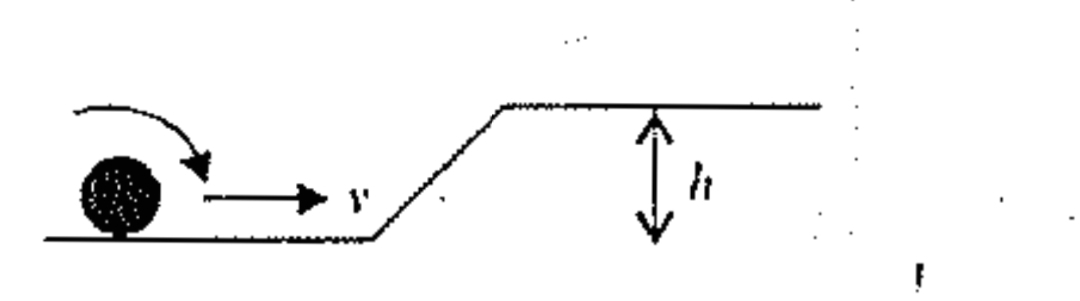
A solid sphere is rolling on a frictionless surface, shown in figure with a translational velocity v m/s. If it is to climb the inclined surface then v should be
≥ √10/7gh
≥ √2gh
2gh
10/7gh
Correct Answer
Detailed Explanation
To determine the minimum velocity needed for a solid sphere rolling on a frictionless surface to climb an inclined surface, we need to analyze the energy transformations involved in the motion of the sphere.
Step-by-Step Explanation
-
Understanding the Situation:
- A solid sphere has both translational and rotational motion while rolling. When it climbs an incline, its kinetic energy is converted into gravitational potential energy.
-
Kinetic Energy of the Sphere:
- The total kinetic energy of a solid sphere rolling without slipping is given by:
Where:
- is the mass of the sphere,
- is the translational velocity,
- is the moment of inertia of the sphere,
- is the angular velocity.
For a solid sphere, the moment of inertia is:
And since (for rolling without slipping), we can substitute:
Therefore, the total kinetic energy becomes:
-
Gravitational Potential Energy:
- When the sphere climbs to a height , the gravitational potential energy gained is:
-
Energy Conservation:
- For the sphere to just reach the height , the initial kinetic energy must equal the potential energy at height :
Dividing both sides by (assuming ):
Rearranging gives:
Taking the square root, we find the minimum velocity :
Conclusion
Thus, the correct answer is:
A)
Why Other Options Are Incorrect:
- B) : This value is lower than the required minimum velocity and does not account for the rotational kinetic energy of the sphere.
- C) : This option is not dimensionally consistent since it does not represent a velocity but rather an energy term.
- D) : Similar to option B, this is not a velocity but an energy term, and also does not satisfy the energy conservation equation derived above.
In summary, the calculations show that the correct answer must consider both translational and rotational kinetic energy, leading us to conclude that the solid sphere must have a minimum velocity of to successfully climb the incline.
Found an issue with this question?
Related Questions
More from Mechanics
A football player is moving southward and suddenly turns eastward with the same speed to avoid an opponent. The force that acts on the player while tu...
A bullet from a gun is fired on a rectangular wooden block with velocity u. When bullet travels 24 cm through the block along its length horizontally,...
The potential energy of a long spring when stretched by 2 cm is U. If the spring is stretched by 8 cm, potential energy stored in it will be: